
An orphan iftar donation is a targeted act of charity that funds the breaking-of-fast meal for a child who has lost one or both parents and lacks a family income to cover it. It differs from general Ramadan food aid, which spreads across mixed households. According to UNICEF, about 140 million children worldwide meet the definition of orphan, and many live in communities where a single iftar meal costs less than $2 USD. The donation applies to any Muslim donor globally. Timing matters: iftar donations carry extra reward during Ramadan but remain valid as sadaqah year-round. In 2025, displacement across Palestinian, Rohingya, and Bangladeshi communities has pushed food insecurity among orphaned children to some of its highest recorded levels.
Orphan Iftar Donation: Quick Answer
- What it is: A charitable gift that pays for one orphaned child’s iftar meal, distinct from general food aid targeting mixed households.
- Who it applies to: Any Muslim donor worldwide giving on behalf of a child who has lost a parent and lacks sufficient household income.
- How much: A single orphan iftar meal costs roughly 1–2 USD in most regions where aid organisations operate.
- When: Most impactful during the 29–30 nights of Ramadan, but valid as ongoing sadaqah at any point in the year.
- Where: Reaches orphaned children in Bangladeshi, Palestinian, Rohingya, Somali, and Sudarian communities, among others.
- Main rule: Donations given with sincere intention (niyyah) during Ramadan count toward a donor’s Ramadan reward, even if the meal is prepared outside the donor’s country.
- Most common mistake: Donors assume “orphan” means both parents are deceased. Islamic scholarship and UNICEF both define an orphan as a child who has lost their father, even if the mother is living.
Why Orphan Iftar Donation Matters Right Now
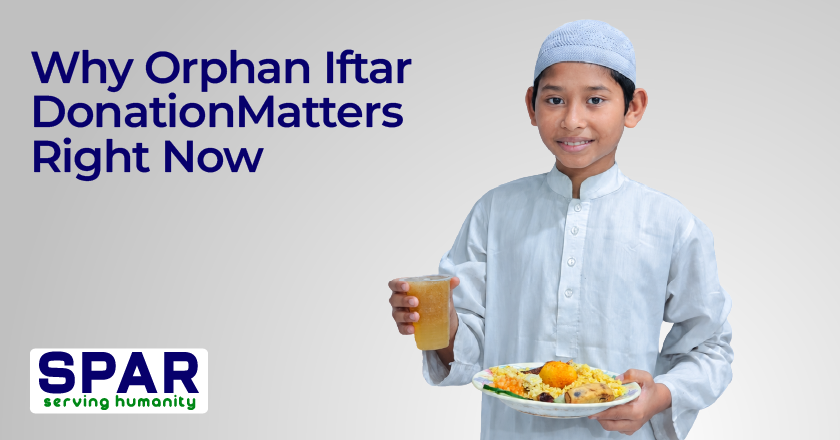
Ramadan intensifies every hunger gap orphaned children already face. Most families pull together for iftar. An orphan often can’t. UNICEF data shows food insecurity among children in conflict-affected and displaced communities rises sharply during religious seasons, when food prices climb and informal support networks thin out. The Quran singles out the orphan by name more than 20 times, and the Prophet Muhammad (ﷺ) linked care for orphans directly to closeness to him in Jannah (Sahih al-Bukhari). For donors looking to act, our orphan sponsorship program at SPAR shows how sustained support across Ramadan and beyond builds something more than one meal. One iftar matters. But it’s often the start of a longer story.
Key Facts About Orphan Iftar Donation Most Donors Don’t Know
The word “orphan” in Arabic, *yateem*, refers specifically to a child who has lost their father before reaching puberty. This is the classical Islamic definition used by scholars including Imam al-Nawawi and Ibn Kathir, and it shapes who qualifies for this kind of targeted charity. A child with a living but absent father, or one displaced from family by conflict, may not qualify under strict fiqh, though general sadaqah still covers their need. The World Food Programme estimates that in some of the hardest-hit communities across sub-Saharan Africa and South Asia, a full iftar for one child costs between $1.50 and $3 USD. Pew Research puts the global Muslim population at about 1.8 billion. That means the collective capacity to fund every orphan’s iftar during Ramadan exists many times over. The gap isn’t resources. It’s awareness.
Does the Definition of “Orphan” Affect Who Receives Iftar?
Yes, it does. In classical Islamic scholarship, an orphan (*yateem*) is a child who has lost their father before reaching puberty. This definition, confirmed by scholars including Imam al-Nawawi and Ibn Kathir, shapes who qualifies under targeted orphan iftar donation programs. A child whose father is absent through imprisonment or migration may not meet this threshold under strict fiqh. But the broader obligation of sadaqah covers them. Many programs, including those run by field-based organizations, apply a wider welfare lens. They prioritize the most vulnerable children regardless of technical classification, while keeping fiqh-rooted definitions visible for donors who want clarity.
Who Is Most Affected by Orphan Hunger During Ramadan?
Children under twelve in conflict-affected and disaster-prone regions face the steepest risk. UNICEF data points to sub-Saharan Africa and South Asia as home to the largest share of orphaned children globally, with tens of millions lacking consistent adult support. Bangladeshi, Somali, and Palestinian communities carry a disproportionate burden. Boys and girls in this age group are the most physically affected by missed iftar meals. Their bodies are still developing. Missing the evening meal is not just hunger. It disrupts sleep, concentration, and emotional stability. These are the children that orphan iftar donation programs are built to reach.
Why Younger Children Are More at Risk
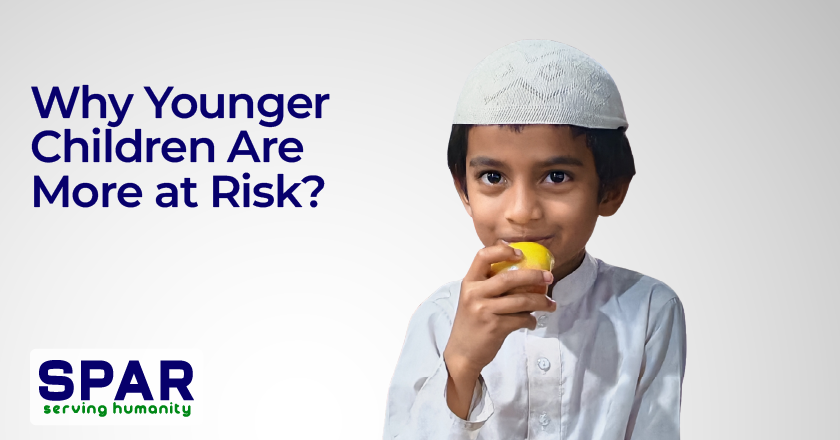
Children under five in orphaned households face a compounding risk. According to WHO nutrition data, early childhood is the window where protein and calorie deficiency does lasting harm. Missing iftar during Ramadan is not an isolated event for many of these children. It sits on top of chronic food insecurity. A single meal can bridge a critical gap. That is why programs targeting this age group treat Ramadan not as a seasonal moment but as a recurring window for sustained nutritional support.
The Role of Female-Headed Households
When a father dies, the mother often becomes the sole provider. Many Rohingya and Somali widows in displaced communities manage three or more children with no formal income. The pressure of Ramadan, with its social expectations around iftar, falls hardest on these women. They face a choice between feeding their children and feeding guests, between dignity and survival. Orphan iftar donation programs that work directly with female-headed households remove that impossible choice, at least for one meal, during the holiest month.
Common Misconceptions About Orphan Iftar Donation
Many donors assume one iftar donation covers a full family for the month. In most field contexts, it does not. A single orphan iftar donation typically funds one meal for one child on one evening. According to World Food Programme cost estimates, a full iftar for one child in high-need areas runs between $1.50 and $3. To cover a child’s iftar for all thirty days of Ramadan costs around $45 to $90. This gap between perception and reality matters. It means some donors give once and feel the job is done. But children need iftar every night, not just one.
How Small, Consistent Giving Changes the Outcome
One iftar gift is meaningful. Thirty is transformative. The difference between a one-time contribution and a month-long commitment is not symbolic. It is nutritional, emotional, and relational. Children who receive consistent support across Ramadan show better engagement and less distress, according to field observations reported in humanitarian nutrition studies. The teams working alongside orphaned families in Bangladeshi and Somali communities rarely make headlines. They show up, week after week, month after month. That quiet consistency is what turns a seasonal act of faith into a lasting change. Real impact here is rarely sudden. It builds, slowly.
What an Orphan Iftar Donation Really Means in Practice
An orphan iftar donation is not a single act. It is a choice to stay present through all thirty nights. UNICEF estimates that over 140 million children worldwide have lost one or both parents. Many live without a consistent adult to prepare their evening meal during Ramadan. According to World Food Programme cost data, a child’s full iftar in high-need areas costs between $1.50 and $3 per night. That means thirty nights costs $45 to $90. Knowing this helps a donor plan with purpose, not just give once and step back.
Why Ramadan Consistency Matters Most for Orphaned Children
Ramadan is not just a month of fasting. For orphaned children, it is a month when the absence of a parent becomes most visible. Every family around them has someone preparing the meal. Humanitarian nutrition research shows that children who receive steady support across the full month show better emotional stability than those who receive a single gift. The meal itself matters. But so does knowing it will come again tomorrow. Consistent giving addresses both.
How to Think About the Full Month
A $3 nightly iftar across thirty nights costs $90. Many donors can cover this in one decision. Others spread it across the month. Both approaches work. What matters is closing the gap between a one-time gift and full-month coverage. Organisations running sustained orphan support programs, including SPAR, build systems around this consistency. Their work across Bangladeshi, Somali, and Palestinian communities shows that structured monthly giving, rather than impulse giving, produces measurable improvements in child wellbeing.
Behind every fed child is a quiet chain of people who chose to stay involved past the first night of Ramadan. SPAR’s work across multiple regions carries on because people make that choice, again and again, not just once. The orphans in the communities we serve do not need a grand gesture. They need someone who shows up each evening, through a donation that keeps arriving. See how this work continues.