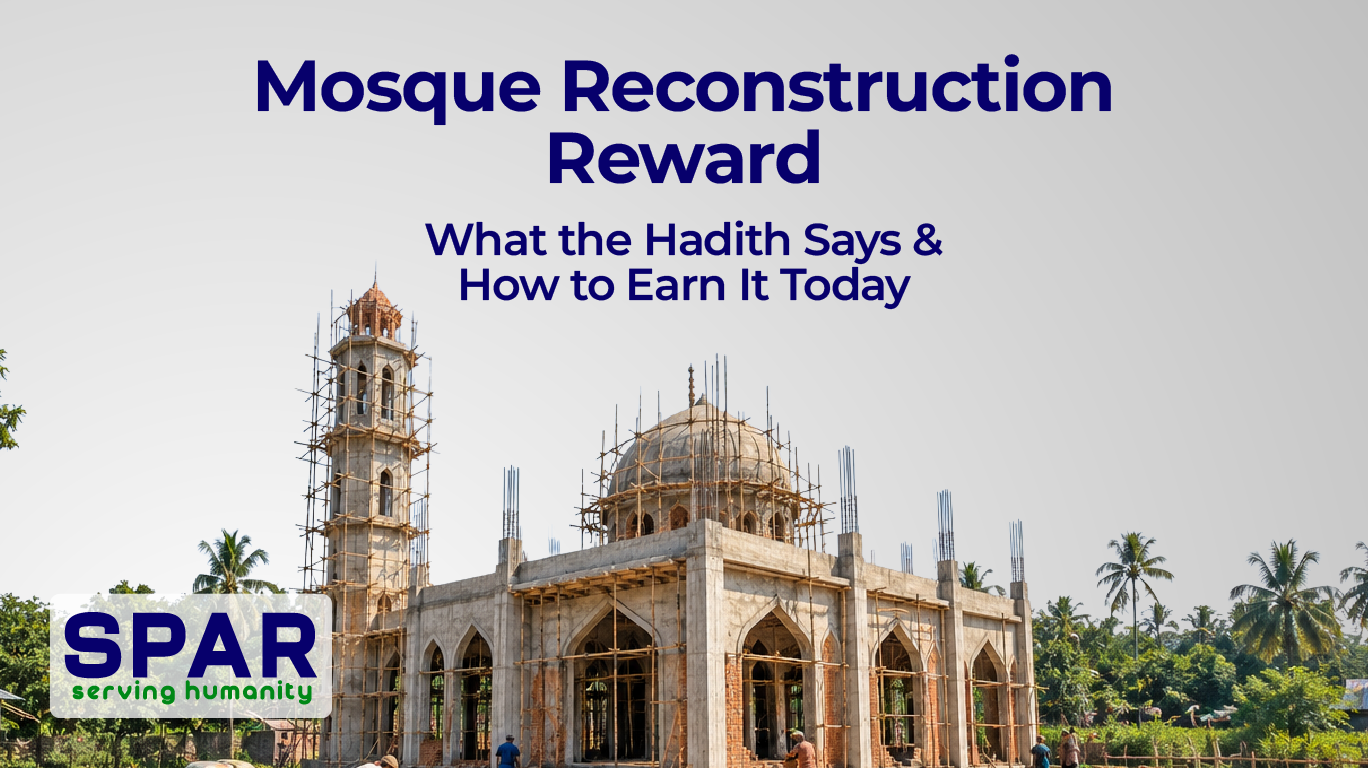
The mosque reconstruction reward refers to the divine promise recorded in authentic hadith: anyone who builds or rebuilds a mosque for the sake of Allah receives a palace in Jannah in return. This differs from general sadaqah jariyah, which covers all ongoing charity. The hadith is graded sahih by Imam al-Nawawi and appears in both Sahih al-Bukhari and Sahih Muslim. It applies to every Muslim, whether they fund an entire rebuild or contribute part of the cost. The key condition is sincerity: the act must be done solely for Allah’s pleasure, not for recognition. In 2026, with hundreds of mosques destroyed across conflict zones, this reward has never felt more urgent or more within reach.
The mosque reconstruction reward is Allah’s promise of a palace in Jannah for every Muslim who builds or rebuilds a mosque for His sake. This reward differs from general sadaqah jariyah, which covers all ongoing charity. The hadith is graded sahih and recorded in both Sahih al-Bukhari and Sahih Muslim. It applies to any Muslim who contributes, not only those who fund an entire build. The one condition that changes everything: the act must be done purely for Allah, with no desire for recognition.
Mosque Reconstruction Reward: Quick Answer
- What it is: A divine promise of a palace in Jannah for any Muslim who builds or rebuilds a mosque for Allah’s sake.
- Who it applies to: Every Muslim contributor, whether funding a full rebuild or a partial share of reconstruction costs.
- The hadith source: Recorded in Sahih al-Bukhari (Hadith 450) and Sahih Muslim, graded sahih by Imam al-Nawawi.
- Key condition: The act must be done sincerely for Allah alone. Any desire for public praise cancels the reward.
- Common confusion: Many assume you must fund the entire mosque. Scholars, including Ibn Uthaymeen, confirm a partial contribution still earns the full promise.
- Ongoing reward: The builder keeps earning hasanat for every prayer performed in that mosque, even after death.
- Most common mistake: Funding a mosque rebuild with mixed intentions (showing others, gaining status) and losing the reward entirely without realising it.
Why Mosque Reconstruction Reward Matters Right Now
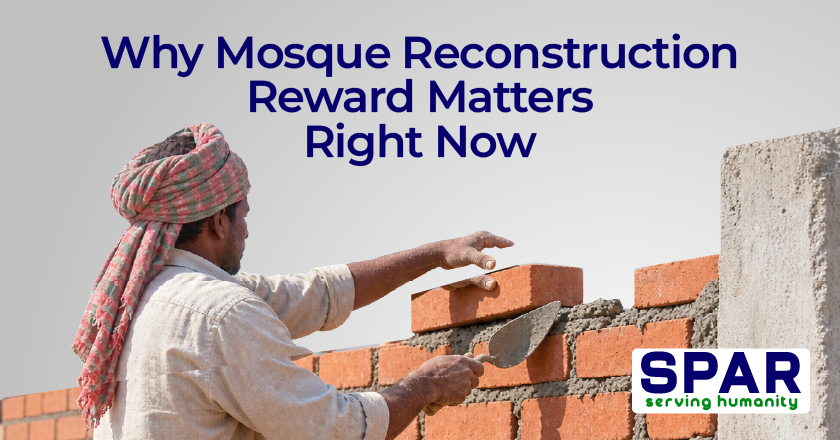
Mosques aren’t only places of worship. They’re schools, shelters, and community anchors. According to the United Nations Office for the Coordination of Humanitarian Affairs (OCHA), armed conflict has damaged or destroyed religious and civic infrastructure across multiple regions where Muslim communities live. When a mosque falls, so does the social fabric around it. Families lose their gathering point. Children lose their madrasa. That’s why the mosque reconstruction reward isn’t a distant theological concept. It’s a live opportunity for donors today. SPAR’s mosque and community infrastructure work puts that opportunity into direct action, helping restore the spaces that hold communities together. The hadith makes one thing clear: every brick laid for Allah’s sake starts building something in Jannah too.
Does the Mosque Reconstruction Reward Apply to Partial Rebuilds?
Yes. Scholars across the major madhabs agree that the mosque reconstruction reward covers any genuine contribution to a mosque’s structure. A full rebuild carries the greatest weight. But funding a new roof, reinforcing damaged walls, or restoring a flood-damaged prayer hall all fall within the scope of what the Prophet (ﷺ) described. Ibn Uthaymeen clarified this in his rulings on charitable acts: sincerity and effort matter more than scale. A donor who funds one repaired column with a pure intention earns a real, lasting reward. Allah does not overlook small deeds done well.
What About Renovations That Aren’t Structural?
Replacing broken windows, installing clean water facilities, or adding proper ablution areas all count as acts of benefit to the mosque community. Scholars classify these as sadaqah jariyah because they extend the mosque’s function and preserve its use. The reward depends on whether the act sustains or improves the mosque’s ability to serve worshippers. If it does, the intention can carry the full weight of mosque reconstruction reward, even if the work is modest.
Does Donating Online Count the Same Way?
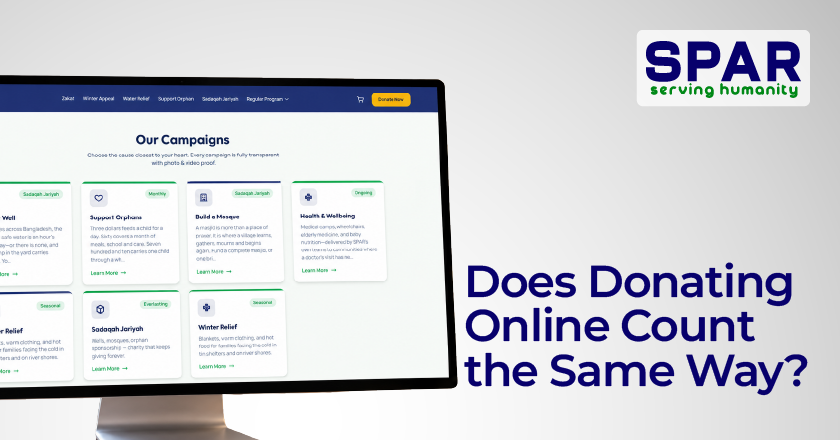
The method of giving doesn’t change the ruling. Whether a donor walks a brick to the site or transfers funds remotely, the intention and the outcome are what Islam evaluates. Classical fiqh has always separated the act of giving from the physical mechanics of delivery. What matters is that the funds actually reach the mosque and are used for that purpose. Transparent charitable channels that report how funds are used carry an added benefit: they protect the donor’s intention by confirming the outcome.
Common Misconceptions About the Mosque Reconstruction Reward
Many Muslims assume the mosque reconstruction reward applies only to the person who commissions the full build. That’s not accurate. The hadith recorded in Sahih al-Bukhari and Sahih Muslim uses language that scholars have consistently read as broad. Contributing with wealth, labour, or even coordinating the effort all attract reward. Another common mistake: people assume the reward stops when construction ends. It doesn’t. Because the mosque goes on serving, the donor goes on earning. The reward is tied to the ongoing act of worship inside the building, not the one-time event of laying the last stone.
Who Benefits Most From Mosque Reconstruction?
Displaced and conflict-affected communities feel the loss of a mosque most sharply. When families lose their mosque, they lose daily prayer in congregation, access to Islamic education for children, and the social infrastructure that holds a neighbourhood together. According to UNICEF, children in crisis zones are among the most vulnerable to long-term educational loss when community institutions collapse. Rohingya communities in Cox’s Bazar, Gazarian families rebuilding after bombardment, and Bangladeshi villages hit by cyclones all share this experience. The mosque is rarely just one building. Its reconstruction serves dozens of interlocking needs at once.
How Sustained Giving Multiplies the Mosque Reconstruction Reward
One large gift builds a mosque. But mosques built quickly and without ongoing care often fall into disrepair within a few years. Scholars of Islamic finance note that waqf (endowment) structures exist precisely because sustained giving outperforms single contributions over time. A donor who gives a modest amount annually toward mosque upkeep may earn a greater cumulative reward than one who gives once and walks away. The structure stays functional. The worshippers keep praying. The hasanat keep flowing. Real change in struggling communities rarely comes from a single act. It comes from quiet, continued attention, season after season, long after the headlines are gone.
What Mosque Reconstruction Reward Means for You
The mosque reconstruction reward is not a distant theological idea. It is a living, active stream of hasanat that flows for as long as the mosque functions. Ibn Majah records that the Prophet Muhammad (ﷺ) connected the reward of building a house for Allah directly to Allah’s promise of a house in Jannah. Scholars like Imam al-Nawawi confirm this reward extends beyond the act of building to every prayer performed inside. Whether you give to a new build or ongoing upkeep, the reward keeps returning. That continuity matters most.
Why Ongoing Upkeep Earns Its Own Reward
Many Muslims focus on the first gift. But a mosque that stands for decades needs care across those decades. The roof needs repair. The wudu area needs maintenance. The lighting must keep working. Each act of upkeep keeps the prayers flowing. And flowing prayers mean flowing reward. Ibn Qayyim wrote that sadaqah jariyah is most powerful when it produces benefit without interruption. Upkeep is the quiet engine behind that unbroken benefit.
How Communities Multiply the Reward Together
No single donor rebuilds a mosque alone. Communities pool small amounts and create something lasting. This is the wisdom behind collective waqf structures used across the Muslim world for centuries. UNICEF notes that community-level investment in shared spaces reduces long-term vulnerability in crisis-affected populations. When Rohingya families, Bangladeshi villagers, and Palestinian communities rebuild together, the reward multiplies across every contributor. Collective giving is not a compromise. It is often the most powerful form of it.
Behind every rebuilt mosque is a long chain of quiet decisions. Someone chose to give when the roof leaked. Someone else paid for the windows. A third person funded the water supply. At SPAR, we see this pattern in the communities we serve. The work of rebuilding sacred spaces is patient, ongoing, and often invisible. But the reward is not. See how this work continues.