
A well for deceased is a water source built in the name of someone who has died. It counts as sadaqah jariyah, a form of charity that earns ongoing reward even after death. The Prophet Muhammad (peace be upon him) confirmed this in an authentic hadith recorded in Sahih Muslim. Any Muslim can commission one on behalf of a parent, sibling, or loved one. Every sip of water drawn from that well continues to benefit the soul.
Why a Well for the Deceased Matters Right Now
Clean water remains one of the world’s most urgent needs. According to WHO, about 2.2 billion people still lack safe drinking water at home. A well built in a deceased person’s name addresses both a spiritual need and a physical one. It gives the departed a source of ongoing reward. And it gives a living family access to water they’d otherwise walk hours to find. That’s a rare act: one deed that serves two worlds at once. SPAR’s well and water programs connect grieving families with this exact opportunity, placing wells in communities that need them most.
Key Facts About Wells for the Deceased Most People Don’t Know
Not all water charity qualifies as sadaqah jariyah under Islamic scholarship. The water must be genuinely useful to others, not just symbolic. Imam al-Nawawi noted that sadaqah jariyah requires ongoing benefit to reach ongoing reward. A well in a dry, rural area fulfills this condition clearly. According to UNICEF, children in water-scarce regions spend an average of six hours each day collecting water. A single well can free an entire village from that burden. The gift costs far less than most donors expect, with functional community wells starting at around $500 USD in many regions.
Can a Well for the Deceased Be Built in Someone Else’s Name?
Yes. A well can be dedicated to any deceased Muslim, whether a parent, spouse, sibling, or friend. The donor funds the well. The reward flows to the person named. Islamic scholars agree on this point. Ibn al-Qayyim wrote that the deceased benefit from charity given on their behalf by the living. The deed is registered in their name before Allah. Many families choose this act specifically because it feels personal. It’s not just charity. It’s a conversation between two worlds, one still turning, one already still.
Does the Deceased Need to Have Asked for It?
No. The deceased doesn’t need to have requested it. Scholars like Ibn Baz confirmed that a living person can give sadaqah on behalf of the dead without prior permission. The Prophet Muhammad (peace be upon him) was asked whether a man could give charity on behalf of his deceased mother. He said yes, and that she would receive the reward. This ruling appears in Sahih al-Bukhari. It means that a son, daughter, or friend can act without a will or instruction. The intention of the donor is enough.
What If the Deceased Was Not Religious?
Scholars differ here, but the majority position is that charitable acts benefit the deceased regardless of their level of practice in life. Allah’s mercy is not limited by how a person lived. The act reflects the donor’s sincerity as much as anything else. Families who feel uncertain about this can make du’a alongside the donation, asking Allah to accept it and have mercy on the person. That combination of action and supplication is encouraged in many classical texts.
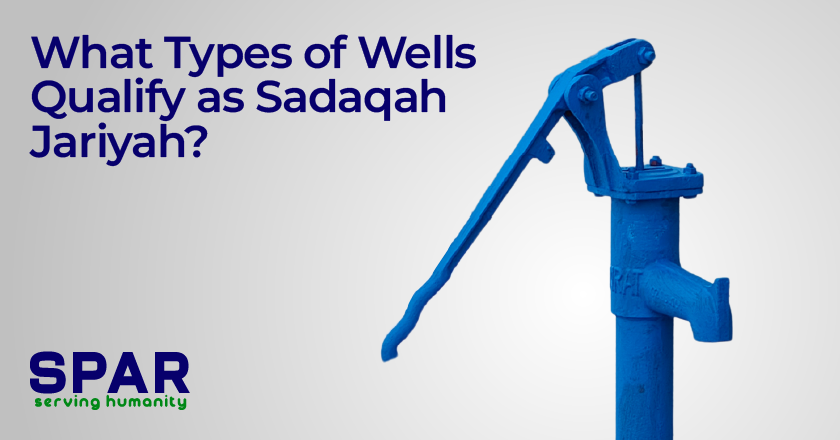
What Types of Wells Qualify as Sadaqah Jariyah?
Not every water source qualifies equally. The core condition is ongoing public benefit. A private well used by one family carries less weight than a community well used by hundreds. Scholars require that the water genuinely reaches those who need it. Deep boreholes in rural, water-scarce areas meet this standard clearly. Hand-pump wells in villages without piped water do too. Rainwater collection systems can also qualify if they provide consistent access. The key test is simple: does this water reach people who would otherwise go without?
Hand-Pump Wells vs Borehole Systems
Hand-pump wells are common, low-cost, and fast to build. A basic hand-pump well can serve 200 to 300 people and costs far less than a full borehole system. Borehole systems go deeper, often 60 to 100 meters, and serve larger populations. They require drilling equipment and more technical installation. Both types qualify as sadaqah jariyah if maintained and used regularly. According to WHO, groundwater from properly constructed boreholes carries significantly lower contamination risk than surface water. For a well for the deceased, either type works, but borehole wells tend to last longer.
Does Well Maintenance Affect the Reward?
Yes, and this is a point many donors miss. A well that breaks down and falls out of use stops generating ongoing reward. Imam al-Nawawi’s definition of sadaqah jariyah centers on continued benefit. If the benefit stops, the ongoing reward stops too. This is why maintenance matters spiritually, not just practically. Reputable programs build maintenance into their well projects from the start. They train local volunteers and schedule regular checkups. A well built with no follow-up plan is a risk, both for the community and for the continuity of reward it was meant to provide.
Who Benefits Most From a Well Built in a Deceased Person’s Name?
Women and children carry the heaviest burden in water-scarce regions. UNICEF data shows that women and girls account for 80 percent of water collection globally. In Bangladeshi rural communities, Rohingya camps, and Somali villages, young girls often miss school to make long water runs each day. A single community well changes that pattern. It gives girls back their mornings. It spares mothers hours of physical strain. The families who benefit most are those farthest from any piped system, living in flood plains, arid zones, or displacement camps where access shifts constantly.
Wells don’t make headlines. But they quietly reshape daily life for the families who use them. Season after season, the water keeps coming. And somewhere, the name of a departed soul is attached to every cup drawn from that ground.
What a Well Built for the Deceased Means for Those Still Here
A well for a deceased person is one of the most lasting forms of sadaqah jariyah a Muslim can offer. According to UNICEF, over 2 billion people still lack safe drinking water at home. Every cup drawn from a clean well is an act of worship that continues long after the person who funded it has passed. This kind of giving connects the living to the dead through something real and renewable. It gives purpose to grief. It turns loss into legacy.
Does the Reward Continue If the Well Needs Repairs?
Yes. Scholars like Imam al-Nawawi affirm that sadaqah jariyah continues as long as the benefit continues. A well that receives maintenance still produces reward. If a community repairs a pump or replaces broken parts, the original intention stays intact. What matters is that the benefit flows. A well that falls silent produces no reward for anyone. Ongoing care is part of the original act.
How Do You Know the Well Is Still in Use?
Reputable programs provide updates and records on request. Field teams document well status, usage patterns, and any maintenance carried out. Receipts are available on request. Donors can ask for confirmation that the well remains active. The families who use it are the clearest sign. When a mother no longer walks three hours for water, the well is working. That is the report that matters most.
Behind every working well is a decision someone made once, quietly, for someone they loved. At SPAR, we believe that grief and generosity can share the same moment. The water programs we run reach families who have no other source of clean water. Season after season, the wells hold. The reward does too.