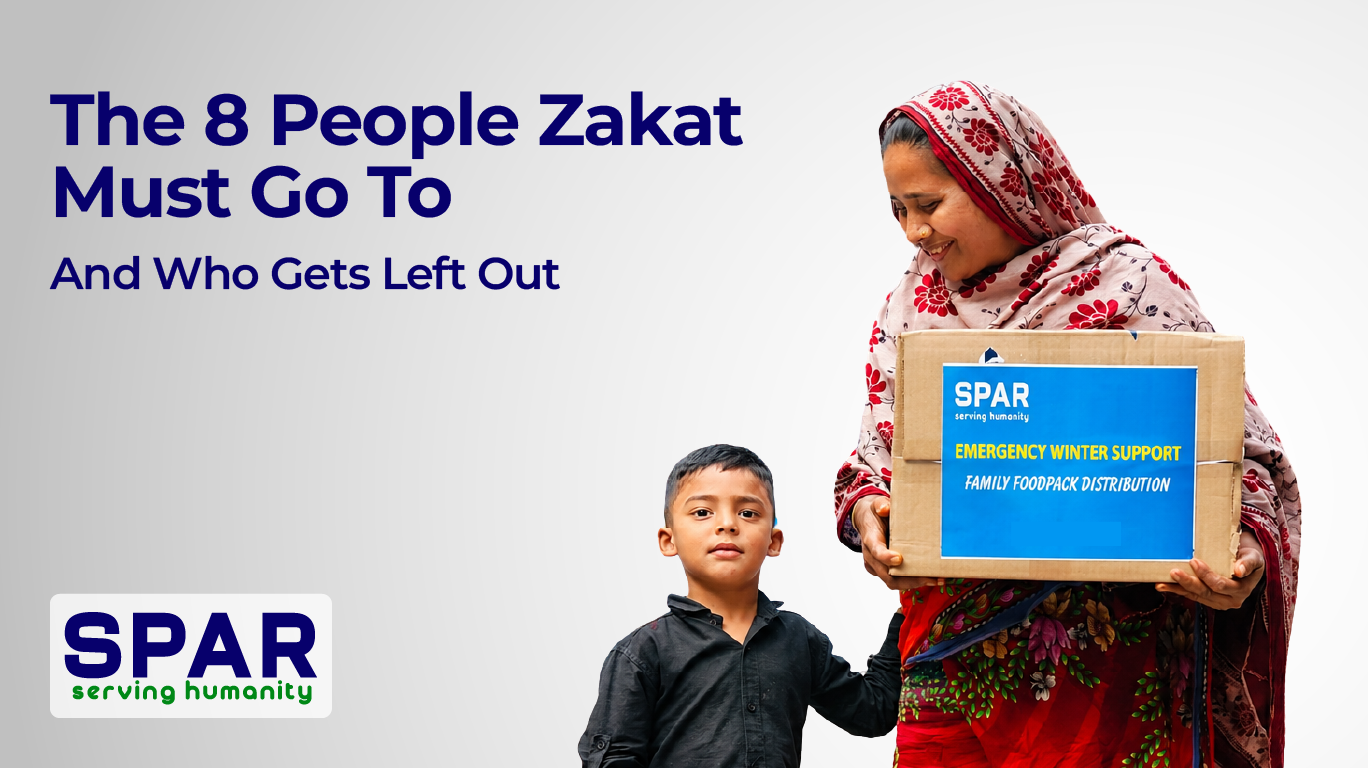
Zakat is payable to eight specific categories of people, named directly in Surah At-Tawbah (9:60) of the Quran. It’s not the same as sadaqah, which can go to anyone. Zakat follows strict rules. The eight categories are: the poor (fuqara), the needy (masakin), zakat collectors, those whose hearts are to be reconciled, people in bondage, the debt-burdened, those striving in the path of Allah, and stranded travellers. A key fact most donors miss: a Muslim cannot pay zakat to their own parents, children, or spouse, because those family members are already their financial responsibility.
Who Is Zakat Payable To: Quick Answer
What it is: Zakat is the obligatory annual Islamic wealth tax, payable to eight categories named in Quran 9:60.
Who receives it: The poor, the needy, debt-burdened individuals, stranded travellers, and other qualifying groups under Islamic law.
How much: Zakat equals 2.5% of total eligible wealth held above the nisab threshold (about $500 USD in gold or silver value).
When: Paid once per lunar year, after eligible wealth has been held for a full hawl (12 lunar months).
Who is excluded: Your own parents, children, or spouse cannot receive your zakat, even if they’re struggling financially.
Main rule: Wealth must exceed the nisab and have been held for one full lunar year before zakat becomes due.
Most common mistake: Donors count total income as zakatable wealth, not net savings held for a full year above nisab.
Why Who Is Zakat Payable To Matters Right Now
Understanding who can receive zakat isn’t just a legal question. It’s one of the most direct ways the ummah closes the gap between wealth and need. According to the World Bank, about 700 million people still live on less than $2.15 USD per day. Many of them fall squarely into the Quranic categories of fuqara and masakin. Getting zakat to the right recipients means those funds reach the people Allah (SWT) intended them for, not a wider pool that dilutes the obligation. You can see how our zakat programs connect this obligation to families who qualify under these categories. Misidentifying recipients doesn’t just waste money. It may invalidate the zakat entirely.
Key Facts About Who Is Zakat Payable To
The eight categories come from a single ayah: Surah At-Tawbah, 9:60. Scholars like Imam al-Nawawi noted that not every category must receive zakat in every distribution. A donor or institution can prioritise the most urgent group. But the recipient must belong to at least one of the eight. Pew Research estimates that global zakat flows could reach between $200 billion and $1 trillion USD annually, yet scholars widely agree that large portions don’t reach valid recipients. This gap exists because many Muslims don’t know the exclusion rules. Immediate family, the wealthy, and non-Muslims (with the exception of those whose hearts are to be reconciled, a category with scholarly nuance) are generally not eligible recipients of zakat.
Can a Non-Muslim Receive Zakat?
Generally, non-Muslims cannot receive zakat. The Prophet Muhammad (ﷺ) specified that zakat is taken from the wealthy among Muslims and returned to the poor among them, as recorded in Sahih al-Bukhari. Most scholars hold this as the baseline rule. But one category creates real discussion: the mu’allafatu qulubuhum, those whose hearts are being reconciled. Classical scholars debated whether this category still applies after the early Islamic state. Imam al-Nawawi noted it was active during the Prophet’s time (ﷺ) to strengthen new Muslims and win over those hostile to Islam. Today, most scholars advise donors to stick to Muslim recipients unless a qualified scholar rules otherwise in specific circumstances.
Common Mistakes When Calculating Who Zakat Is Payable To
Many Muslims pay zakat to the wrong people without knowing it. Paying zakat to a parent, child, or spouse is not valid under the majority scholarly position. These dependants are already your financial responsibility. Zakat covers a separate obligation. Another frequent error is giving to someone who owns assets above the nisab but lives simply. A person with gold, investments, or property above the threshold is not eligible, even if their lifestyle looks modest. According to Pew Research, global zakat flows may reach between $200 billion and $1 trillion USD each year. Yet scholars widely agree that a large portion fails to reach valid recipients. The math matters.
Can I Pay Zakat to a Mosque or Islamic School?
A mosque or Islamic school is not automatically a valid zakat recipient. The eight categories in Surah At-Tawbah 9:60 describe people, not institutions. Some scholars allow zakat to fund religious education if the student falls under “those in the way of Allah,” a category Ibn Kathir linked to spreading knowledge and supporting the faith. But this ruling is not unanimous. Many contemporary scholars, including those from Saudi Arabia’s major fatwa councils, advise using zakat for individuals from the eight categories and using sadaqah for building projects and institutions.
What About Zakat to Orphans?
Orphan children can receive zakat if they are poor. Their father’s death does not by itself qualify them. The test is financial need, not family status. If an orphan has an inheritance, property, or a guardian who provides fully for them, they may not qualify. But in many parts of the world, orphaned children grow up in real poverty, with no income and no reliable support. In those cases, zakat to orphan families is not just valid, it’s among the most impactful uses of the obligation.
Who Is Zakat Payable To When Funds Are Sent Abroad?
Zakat can cross borders. Most scholars agree there is no geographic restriction in the Quran or authenticated hadith. Surah At-Tawbah 9:60 names categories of people, not countries. The Maliki and Hanbali schools both permit sending zakat to Muslims in greater need elsewhere, especially when local poverty is less severe. The key question is always the recipient’s status, not their location. Families in displaced Rohingya communities, Palestinian households, and Bangladeshi villages affected by flooding all face documented, measurable hardship. Zakat sent through a trusted organization that verifies recipient eligibility is fully valid. The obligation does not end at a border.
The communities who depend on this kind of sustained, long-distance support rarely make international news. But their need is consistent. Real change in these places doesn’t come from a single transfer. It comes from year-on-year commitment from donors who treat zakat as a responsibility, not a transaction.
Does the Recipient Need to Know They Are Receiving Zakat?
The recipient does not need to know the funds are zakat. Scholars including Imam al-Nawawi confirmed that the intention of the giver is what counts. Many classical jurists also noted that informing a recipient can cause unnecessary shame, which Islam actively discourages. What matters is that the giver makes a clear internal intention before or during the transfer. If zakat is given through an organization, that organization acts as a wakeel, an agent, and the giver’s intention at the point of delegation is sufficient. SPAR’s approach to distribution reflects this: families receive direct support without the process becoming a source of humiliation.
What Zakat Eligibility Means in Practice
Zakat has eight defined categories of recipients, established in the Quran (9:60). Knowing them helps you give with confidence. The nisab threshold, set against the value of 85 grams of gold, determines whether you owe zakat at all. Once you cross it, your obligation is real and time-bound. According to AAOIFI standards, the most widely referenced benchmark for Islamic finance, that threshold sits near $5,000 in current gold valuations. Giving through a trusted organization that screens for genuine need protects the validity of your zakat. The work continues year-round, not just in Ramadan.
Does the Order of the Eight Categories Matter?
Classical scholars differed on priority. The Hanafi school holds that local fuqara and masakeen take precedence when need is equal. But the Shafi’i and Hanbali positions allow zakat to travel if need is greater elsewhere. What all schools agree on is this: verified hardship matters more than proximity. The categories exist to protect the most exposed. If your giving reaches someone who genuinely qualifies under any of the eight, the obligation is fulfilled.
What If You Are Unsure About a Recipient’s Eligibility?
Uncertainty does not cancel the obligation. Imam al-Nawawi noted in Al-Majmu that a sincere investigation by the giver is sufficient. You are not required to audit every household. You are required to make a reasonable effort to confirm the recipient falls within the eight categories. Delegating to a reputable organization that conducts eligibility checks counts as that effort. The intention you set at the moment of delegation is what matters to Allah.
Behind the legal framework is something simpler. Zakat exists because wealth, left alone, concentrates. The eight categories name the people that concentration leaves behind. Every year, Muslims across the world reset that imbalance. SPAR’s work across Bangladeshi communities, Gazarian families, Rohingya displaced households, and other regions it serves stays grounded in that same idea: consistent, verified, dignified support for those the categories were always meant to reach. See how this work continues.