
Sponsoring an iftar meal means paying for a fasting person’s evening meal so they can break their fast. It’s not the same as giving general sadaqah. The Prophet Muhammad (ﷺ) said whoever feeds a fasting person earns the same reward as the faster, without reducing the faster’s reward at all (Tirmidhi, no. 807). A single iftar meal in many communities costs as little as $3 USD. Any Muslim, anywhere in the world, can sponsor one. The reward doesn’t depend on how much you spend. In Ramadan 2026, with food insecurity rising across multiple regions, the need for sponsored iftars is greater than it has been in years.
Sponsor Iftar Meal: Quick Answer
- What it is: Paying for a fasting person’s evening meal so they can break their fast during Ramadan.
- Who it applies to: Any Muslim donor worldwide, regardless of wealth, age, or location.
- How much: As little as $3 USD per meal in high-need communities, varying by region.
- When: During Ramadan, specifically before or at the Maghrib prayer each evening.
- Where: Distributed to fasting families in need, including Bangladeshi, Palestinian, Rohingya, and Somali communities.
- Main rule: The donor does not need to be present. The reward is confirmed even if the donor and recipient never meet.
- Most common mistake: Thinking the reward is shared and therefore halved. The hadith is clear: both the donor and the faster receive a full, equal reward.
Why Sponsoring an Iftar Meal Matters Right Now
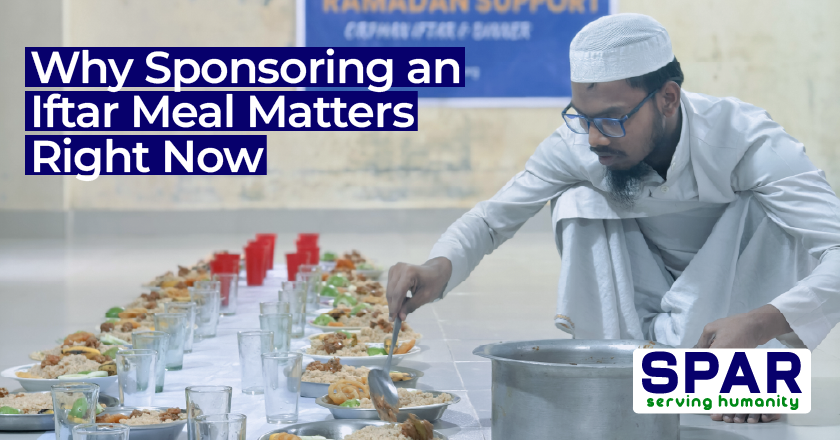
Food insecurity directly shapes who can fast with dignity during Ramadan. The United Nations World Food Programme estimates that over 280 million people face acute hunger globally. Many of them are Muslim. When a family can’t afford food at sunset, the fast doesn’t end with relief. It ends with exhaustion and shame. Sponsoring an iftar changes that. It covers a real gap that no other act quite addresses. You can explore our Ramadan programs at SPAR to see how sponsored meals reach families in the communities we serve. The cost is low. The impact lands the same night.
Key Facts About Sponsoring an Iftar Meal
The hadith recorded in Tirmidhi (no. 807) is one of the most specific reward-statements in the entire Sunnah. It doesn’t say “you’ll earn some reward.” It says the sponsor earns the same reward as the faster. Imam al-Nawawi noted this category of reward-mirroring as one of the clearest examples of Allah’s generosity in giving. According to UNICEF, children in food-insecure households miss up to 40% more meals during high-demand religious seasons when community support drops. A $3 USD iftar can include dates, water, rice, and a protein source. That’s a full, dignified meal. Across Bangladeshi, Palestinian, and Rohingya communities, field teams report that sponsored iftars often serve as the only hot meal a family receives that day.
Who Benefits Most When You Sponsor an Iftar Meal?
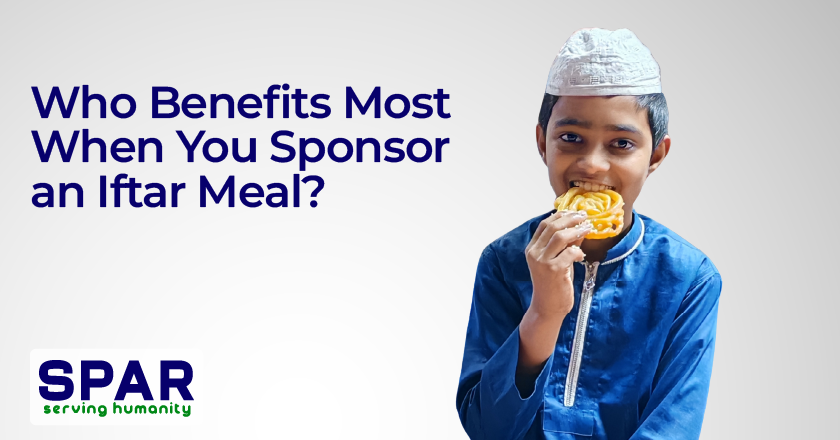
Families living below the food-poverty line feel the weight of Ramadan differently. For them, the fast doesn’t end at the call to prayer. It ends with a question: what do we have to break it with? According to the World Food Programme, about 733 million people face chronic hunger worldwide. Many of them are Muslim families in food-insecure regions. Children under twelve are most at risk. When a sponsored meal arrives, it goes to the people who need it first: the young, the elderly, and households with no working adult. Sponsored iftars close a gap that only widens during Ramadan.
Children in Food-Insecure Homes
UNICEF data shows food insecurity affects children’s cognitive development when it persists across key growth months. Ramadan sits in those months. A child who fasts without a guaranteed break-fast meal carries that stress into the night. Sponsored iftars give children a full meal on time. That matters not just nutritionally. It matters for their sense of dignity inside the home.
Widowed and Female-Headed Households
Across many communities where SPAR works, women who head households alone face the sharpest resource gap. They often have no income source outside informal labor. During Ramadan, their usual support networks shrink. A sponsored iftar reaches them without requiring an application or a visit to an office. It shows up. That’s what makes it different from most forms of structured aid.
Common Misconceptions About Sponsoring an Iftar Meal
Many Muslims assume you need a large amount to sponsor iftar for a family. That’s not accurate. A full iftar in many of the regions SPAR serves costs between $3 and $5. It includes dates, clean water, rice, and a protein. The belief that iftar sponsorship is only for wealthy donors comes from conflating it with larger charity events or mosque banquets. Community-scale sponsorship works on small, repeated contributions. One person can sponsor several nights across a month. The cumulative effect across a community of donors is what builds real food security during Ramadan.
How Does an Iftar Sponsorship Reach Families on the Ground?
Sponsorship doesn’t work through a single transfer. Field teams identify households before Ramadan starts. They note family size, income status, and the presence of young children or elderly members. Meals are then prepared locally, using local ingredients, through local cooks or kitchens. This keeps costs low and money inside the community. Our teams coordinate distribution so meals arrive before Maghrib. Families don’t wait in lines. They receive iftars at or near their homes. The process is quiet and consistent. That consistency is what separates a one-time act of generosity from sustained relief across a full month.
The Prophetic Basis for Feeding Others at Iftar
The Prophet Muhammad (peace be upon him) described feeding a fasting person as one of the most direct paths to reward in Ramadan. The hadith in Tirmidhi (no. 807) is clear: the one who feeds a faster earns the equivalent of that person’s fast reward, without reducing theirs at all. Imam al-Nawawi, in his commentary on this category of hadith, described this as a sign of Allah’s generosity toward those who support others in worship. It’s not just a recommended act. It’s one with a specific, named reward. That framing matters. It places iftar sponsorship inside the structure of worship, not just the category of charity.
What Sponsoring an Iftar Meal Actually Means
Sponsoring an iftar meal is one of the clearest acts of worship in Ramadan. It combines sadaqah, feeding the hungry, and supporting a fellow Muslim’s fast. According to the UN Food and Agriculture Organization, more than 700 million people go to bed hungry on any given night. Many of them are Muslim. Many fast through the day with nothing confirmed for the evening. When you sponsor iftar, you close that gap. The act is simple. The effect is not. A family eats. A fast is honored. And a reward is recorded.
Does the Intention Behind Sponsoring Iftar Change the Reward?
Yes, intention shapes everything in Islamic charity. The Prophet Muhammad (peace be upon him) said deeds are judged by their intentions, as recorded in Sahih al-Bukhari (no. 1). If you sponsor iftar purely for Allah’s pleasure, the reward is full. If you mix in pride or social approval, the reward is reduced. Scholars like Ibn al-Qayyim wrote at length on how sincerity protects the value of a good deed. Keep the intention quiet and private. That is the stronger path.
How Consistent Sponsorship Differs From a One-Time Gift
A single iftar gift feeds one family once. Consistent sponsorship, across a full Ramadan or year-round, builds something the community can rely on. Families plan around it. Children sleep with less anxiety. The relief is not just physical. It becomes a form of stability. Long-term programs, like those SPAR runs in the communities it serves, track who receives meals and when. That consistency turns charity into care.