
Sadaqah donation online means giving voluntary Islamic charity through a digital platform, with no fixed amount and no set deadline. Unlike Zakat, Sadaqah carries no minimum threshold and no annual calculation. The World Bank estimates that over $450 billion USD moves through Islamic finance channels annually, with voluntary giving making up a significant share. Any Muslim can give Sadaqah, regardless of wealth level, as long as the intention is sincere. One condition changes the reward entirely: Sadaqah Jariyah, the ongoing form, continues earning reward after the giver dies. In 2026, digital giving has made this practice more accessible than at any point in Muslim history.
Sadaqah Donation Online: Quick Answer
What it is: Voluntary Islamic charity given at any time, in any amount, through any halal channel including online platforms
Who it applies to: All Muslims globally, with no minimum wealth requirement or annual obligation
How much: No fixed amount. Even $1 USD counts. Sadaqah Jariyah projects like water wells typically start from $30 USD
When: Any time. No deadline, no nisab threshold, no lunar calendar requirement
Main rule: Intention (niyyah) must be for Allah alone. Sadaqah given to impress others loses its reward entirely
Key distinction: Sadaqah is voluntary. Zakat is obligatory. Confusing the two is the most common mistake Muslims make when giving online
Most common mistake: Donors assume Sadaqah replaces unpaid Zakat. It does not. Zakat is a separate obligation that Sadaqah cannot cancel
Why Sadaqah Donation Online Matters Right Now
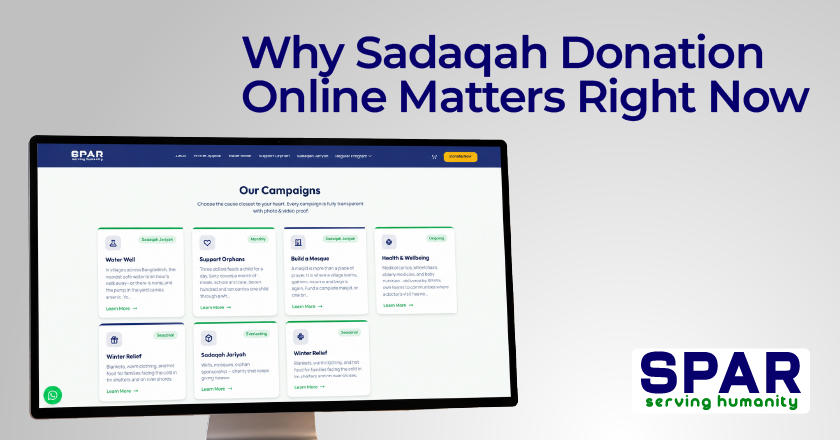
Digital platforms have changed how Muslims fulfil this obligation. A Muslim in London, Dhaka, or Toronto can now complete a Sadaqah donation online in under two minutes and reach Bangladeshi, Somali, or Palestinian families the same day. According to Pew Research, the global Muslim population now exceeds 1.8 billion. That’s a huge pool of potential givers. But online giving also introduces new risks: unverified platforms, unclear fund allocation, and no traceability. Choosing a transparent organisation matters. SPAR’s approach to accountability is visible through our ongoing charity work, where field updates show exactly where funds go. Transparency isn’t a feature. It’s a requirement of honest giving.
Key Facts About Sadaqah Donation Online Most Muslims Haven’t Seen
Sadaqah is older than any formal financial system. The Prophet Muhammad (ﷺ) said: “Every act of goodness is Sadaqah” (Sahih al-Bukhari). That breadth matters when giving online, because it means Sadaqah isn’t limited to money. But money remains the most common form. The UN estimates that 700 million people still live on under $2.15 USD per day, with the highest concentrations across sub-Saharan Africa, South Asia, and parts of the Middle East. These are the same communities that Sadaqah donations reach. Scholar Ibn al-Qayyim wrote that Sadaqah given in secret carries greater reward than public giving. Online platforms that issue private receipts, available on request, honour this principle without advertising the act.
Does Sadaqah Donation Online Count the Same as Giving in Person?
Online Sadaqah carries the same spiritual weight as in-person giving. What matters in Islamic law is the intention behind the gift, not the method of delivery. Imam al-Nawawi wrote that niyyah (intention) precedes every act of worship, and this applies to financial giving too. Some Muslims worry that digital giving feels impersonal or less sincere. But scholars across the modern period have confirmed that any lawful transfer of funds, made with sincerity, fulfils the obligation. The method is a tool. The heart is what counts.
What Types of Sadaqah Can You Give Online?
Online platforms make several forms of Sadaqah accessible to any Muslim with a phone or laptop. The most common types include food support, clean water programs, orphan care, and emergency relief for displaced families. Each of these addresses a different kind of need. UNICEF estimates that about 333 million children worldwide live in extreme poverty, many of them in Bangladeshi, Pakistani, Somali, and Nigerian communities. Some platforms also allow recurring monthly giving, which many scholars describe as more valuable than a single large gift. Consistent support builds programs that last. One payment closes no gap permanently.
Sadaqah Jariyah: The Giving That Outlives You
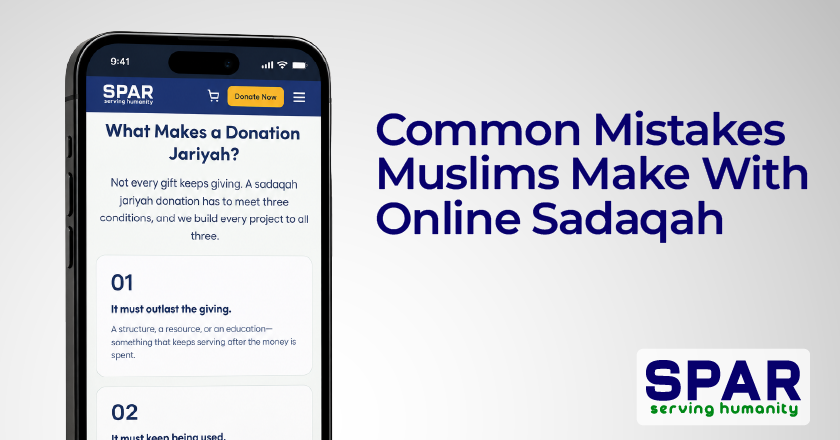
Sadaqah Jariyah is a form of ongoing charity. Its reward continues after the giver’s death. The Prophet Muhammad (ﷺ) listed it as one of three deeds whose reward never stops (Sahih Muslim, Book 13, Hadith 1631). Online platforms now let donors fund long-term projects that qualify, such as water infrastructure, education programs, and Quran teaching. Choosing a Sadaqah Jariyah project online is one of the most rewarding decisions a Muslim can make.
Common Mistakes Muslims Make With Online Sadaqah
The biggest mistake is giving without checking who actually receives the funds. Many donors complete a payment and assume the work is done. But not all platforms disclose how funds move from the donation page to the field. According to the World Bank, weak accountability systems in nonprofit finance remain a global challenge, especially in regions where banking infrastructure is limited. A second common mistake is treating Sadaqah as a one-time act. The communities facing the most need, whether Rohingya families in Cox’s Bazar or Gazarian children in besieged areas, don’t recover from a single moment of generosity. Real change rarely comes from one push. It comes from quiet, sustained attention, season after season.
Who Benefits Most From Sadaqah Donations Online?
Those who benefit most are families living in places where local resources can’t meet basic needs. Orphaned children, widows, and displaced communities make up the largest share of recipients in most long-term programs. The UN Food and Agriculture Organization estimates that about 733 million people face hunger globally, with the sharpest concentrations across sub-Saharan African and South Asian populations. Bangladeshi, Sudarian, and Somali families often face compounding crises: seasonal flooding, food insecurity, and limited access to clean water all at once. Online Sadaqah reaches these communities because it removes geography as a barrier. A donor in one continent can fund a meal, a well repair, or a child’s schooling on another. SPAR’s work focuses on exactly these gaps, through programs that stay present long after the initial crisis passes.
What You Should Know Before Your Next Sadaqah Donation Online
Making a sadaqah donation online is one of the most direct ways to act on your faith. The barrier between intention and impact has never been lower. UNICEF estimates that 333 million children live in extreme poverty, and most of them live in regions where local systems cannot close the gap alone. Online giving lets your sadaqah reach Rohingya families, Gazarian children, Bangladeshi communities, and Somali households without delay. Platforms that verify their work, publish clear program updates, and maintain a long-term field presence are the ones worth trusting. SPAR’s work fits that description.
How to Tell If an Online Sadaqah Platform Is Trustworthy
Not every platform deserves your trust. Look for clear program descriptions, regular field updates, and honest reporting on how funds are used. A trustworthy platform names the communities it serves. It shows the work, not just the promise. According to the World Bank, accountability and transparency are the two strongest predictors of donor trust in nonprofit giving. If a platform can’t answer basic questions about where your money goes, keep looking.
Does It Matter How Often You Give?
It matters. The Prophet Muhammad (peace be upon him) said that the most beloved deeds to Allah are those done consistently, even if small. That hadith appears in Sahih al-Bukhari. A $10 monthly commitment builds more over time than a single $120 gift. Recurring sadaqah funds predictable programs. Field teams can plan water access work, food distribution, and orphan support around steady income. Irregular giving creates gaps. Steady giving creates change.
Behind every lasting change is a long line of people who chose to stay involved. One act of sadaqah starts something. Repeated acts sustain it. The families SPAR serves across its operational regions don’t need a single moment of generosity. They need ongoing attention from a global ummah that remembers them month after month. That’s the kind of presence SPAR is committed to. See how this work continues.