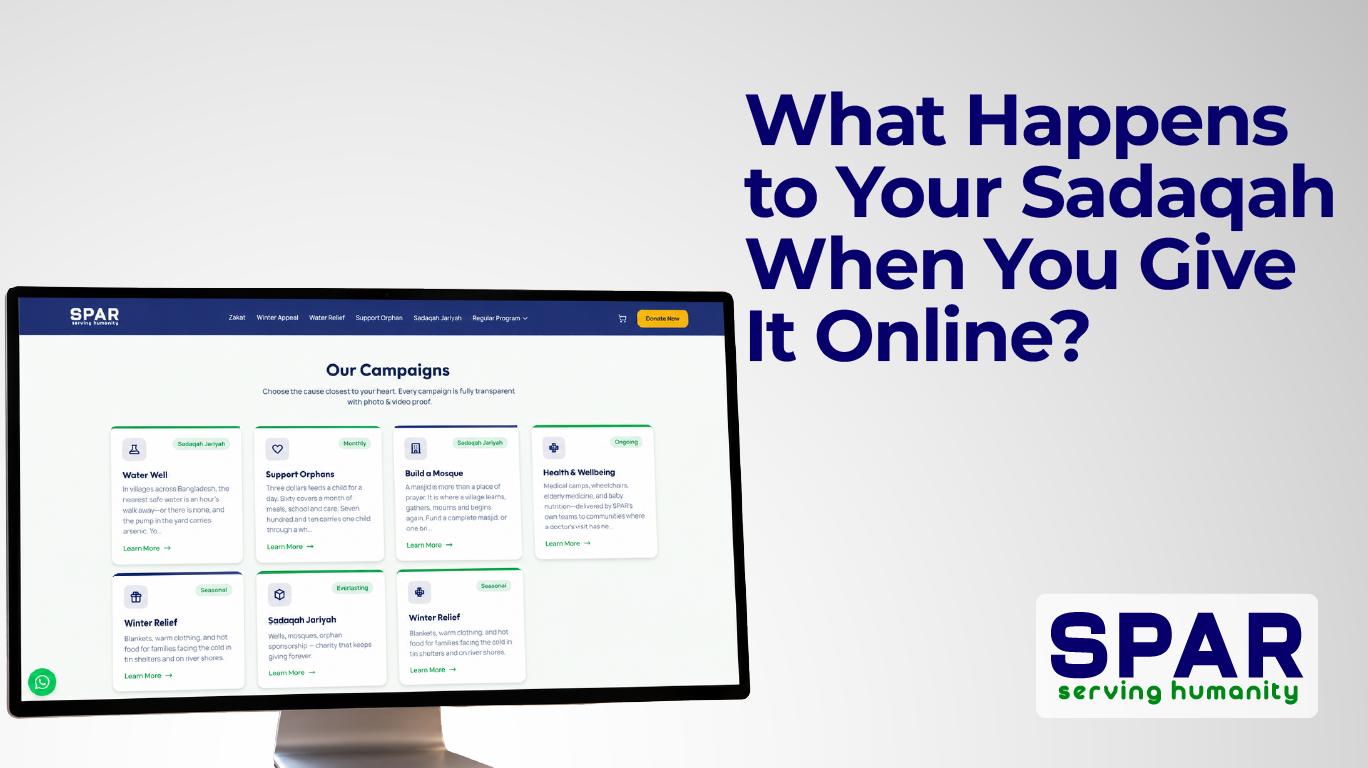
Sadaqah is voluntary charity in Islam, given freely at any time, with no fixed amount and no deadline. Unlike Zakat, sadaqah carries no minimum threshold and no annual calculation. It doesn’t expire, and giving it online counts just as fully as handing cash to a person in need. According to UNICEF, over 333 million children globally live in extreme poverty today, making the need constant and the opportunity real. Any Muslim, regardless of wealth or location, can give sadaqah. The only condition that changes its reward is intention: sadaqah given sincerely for Allah’s sake earns full reward, while sadaqah given for show earns nothing.
Give Sadaqah Online: Quick Answer
What it is: Voluntary charity in Islam, given freely with no fixed amount, no schedule, and no eligibility threshold.
Who it applies to: Any Muslim, man or woman, at any income level, at any time of year.
How much: No minimum. Even $1 USD given sincerely counts. Large or small, the amount is yours to choose.
When: Anytime. Sadaqah has no season and no deadline, though reward multiplies in blessed times like Ramadan.
Main rule: Intention (niyyah) must be sincere. Sadaqah given for reputation or public praise loses its spiritual reward entirely.
Online giving: Transferring funds to a trusted charity online counts as sadaqah. The action completes when the gift leaves your control.
Most common mistake: Confusing sadaqah with Zakat. Zakat is obligatory with a fixed rate (2.5%). Sadaqah is voluntary with no set rate. They are not interchangeable.
Why Giving Sadaqah Online Matters Right Now
The world’s poorest communities don’t wait for Ramadan. Families facing food shortages, displacement, and health crises need consistent support all year. UNICEF data shows that roughly 1 in 6 children globally lives on less than $2.15 USD a day, a figure that hasn’t shifted fast enough despite decades of aid. Online platforms have changed the speed of giving. A donor anywhere in the world can reach a Bangladeshi family, a Rohingya child in Cox’s Bazar, or a Palestinian family in a besieged area within minutes. You can explore SPAR’s ongoing programs and field work to see how long-term sadaqah funding supports real, sustained change. The gap between a donor’s intent and a family’s relief has never been shorter.
Key Facts About Giving Sadaqah Online
Sadaqah is one of the most mentioned acts in the Quran. Allah says in Surah Al-Baqarah (2:261) that those who spend in His cause are like a grain that grows seven ears, each holding a hundred grains. That’s a 700x return described in scripture. The Prophet Muhammad (peace be upon him) said: “Charity does not decrease wealth” (Sahih Muslim, 2588). Scholars like Imam al-Nawawi confirmed this applies to both physical and proxy giving, meaning a trusted intermediary acting on your behalf counts fully. Pew Research estimated the global Muslim population at 1.8 billion in 2015, with that figure projected to reach 2.2 billion by 2030. Even a fraction of that community giving sadaqah online regularly would represent one of the largest voluntary wealth transfers in human history.
Does Giving Sadaqah Online Count in Islam?
Yes, giving sadaqah online counts fully in Islam. Scholars including Imam al-Nawawi confirmed that using a trusted intermediary to deliver charity is valid. The intention sits in your heart. The action reaches the recipient through a reliable channel. Online platforms today act as that intermediary, the same way a merchant or trusted friend once did in the early Muslim community. What matters is that the money reaches a genuine need and your niyyah is sincere. The method of transfer does not change the reward. It never has.
Common Mistakes When You Give Sadaqah Online
Many Muslims give once and consider the matter closed. But sadaqah jariyah, ongoing charity, carries a different weight. The Prophet Muhammad (peace be upon him) said that when a person dies, their deeds stop except for three: ongoing charity, knowledge others benefit from, and a righteous child who prays for them (Sahih Muslim, 1631). A single payment plants a seed. But recurring giving sustains the root. Most donation platforms today let you set a weekly or monthly amount. That small step turns a moment of generosity into something that outlives you.
Giving Without Verifying the Cause
Not all online campaigns are equal. Some lack transparency about how funds are used. Others collect for causes that never reach the people pictured. Before you give sadaqah online, check whether the organisation publishes field reports. Look for named programs, not just photos. A trustworthy charity shows you where the money goes, not just where it came from. SPAR publishes ongoing field updates so donors can see the real work behind each program.
Waiting for a “Big Moment” to Give
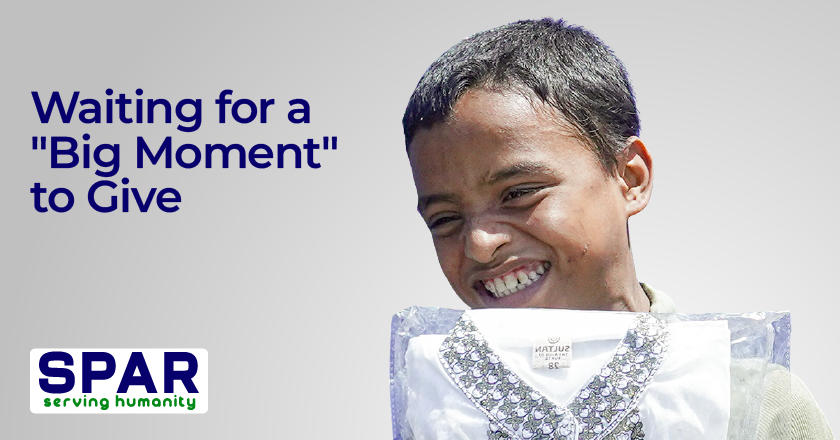
Many donors wait for Ramadan or a crisis headline before they act. But the families who need help don’t wait for a news cycle. According to UNICEF, around 333 million children globally lived in extreme poverty as of recent estimates. That number doesn’t shrink between Ramadan and Dhul Hijjah. Small, regular amounts given year-round do more sustained good than one large payment timed to a season. The quiet months matter just as much as the celebrated ones.
Who Benefits Most When Muslims Give Sadaqah Online
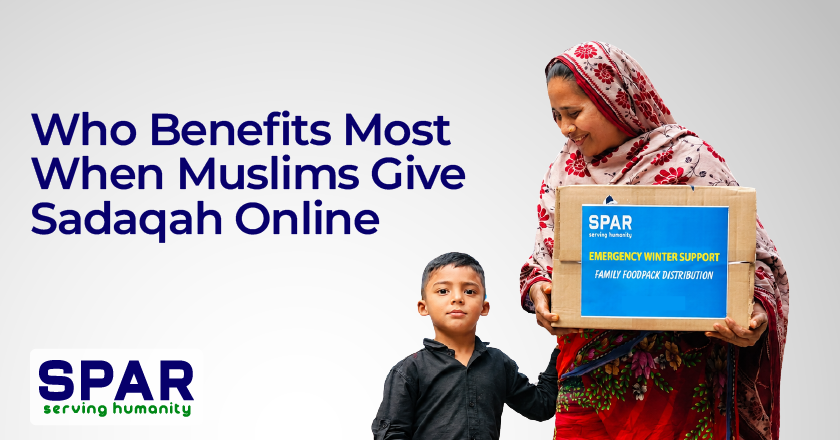
Orphans, widows, and displaced families benefit most. The Quran places these groups at the centre of Islamic social responsibility. Allah says in Surah Al-Baqarah (2:177) that righteousness includes giving wealth to those in need, orphans, the poor, and travellers. Rohingya communities, Palestinian families, and Bangladeshi villages affected by flooding sit among the most vulnerable groups today. According to the UN Refugee Agency, Rohingya refugees in Cox’s Bazar make up one of the largest and most underfunded refugee populations in the world. These communities depend on consistent giving, not occasional spikes.
How Small Amounts Add Up When Donors Give Sadaqah Online
$10 sounds small. But across a community of givers, it builds something real. A water point in a rural area can cost as little as $500 to construct and serve hundreds of families for years. When many donors give sadaqah online in small, regular amounts, the collective pool funds infrastructure that no single donor could manage alone. This is the ummah’s model, described in Sahih al-Bukhari (2989), where the Prophet (peace be upon him) encouraged collective giving for shared needs. The families we support across multiple regions don’t need one hero. They need many ordinary people deciding, quietly and consistently, that this work is worth their attention.
What Giving Sadaqah Online Means for You Right Now
Muslims worldwide give sadaqah online more than ever before. According to the UN, over 700 million people still lack access to clean water. Many more face hunger, displacement, and loss. The tools to act are simple now. A phone. A few minutes. A clear intention. When you give sadaqah online through a trusted channel, the transfer is instant and the record is clear. The work that follows is long and quiet. It reaches Bangladeshi villages, Palestinian families, Rohingya communities, and others far from the headlines.
Does the Amount You Give Sadaqah Online Matter?
Every amount builds something real. UNICEF estimates that $30 can fund clean water access for one family for a year. Small, repeated transfers reach communities that need consistent support, not a single wave of funding. The ummah has always worked this way. Many hands, each carrying a little, lift what no single person could.
How Platforms Have Changed Where Sadaqah Goes
Giving sadaqah online now moves money across borders in seconds. According to the World Bank, digital payment infrastructure has expanded access to financial services across South Asia and sub-Saharan Africa. This means that Bangladeshi families, Somali communities, and Rohingya refugees can receive support faster than ever. But speed is only useful when the organisation on the other end has long-term programs, not just short-term responses.
Behind every steady improvement in a community’s life is a long line of people who kept showing up. Not because of a campaign. Because they believed the work was worth their continued attention. SPAR carries out this quiet, sustained work across multiple regions, and the commitment does not stop when the headlines do. See how this work continues.