Zakat water well donations use a portion of a Muslim’s annual Zakat or sadaqah jariyah to fund clean water access for communities in need. Unlike one-time relief, a water well serves a village for years after it’s built. According to WHO, about 703 million people worldwide still lack clean drinking water. Any Muslim who meets the nisab threshold can direct Zakat-eligible funds toward a well. This makes it one of the most lasting acts of worship in Islamic giving.
Why Zakat Water Well Donations Matter Right Now
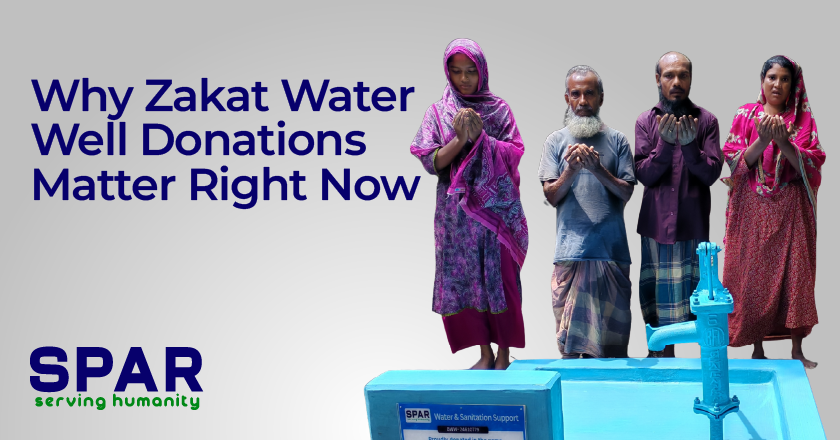
Clean water is not a distant problem. WHO data shows that unsafe water causes roughly 1.4 million deaths each year, most of them children under five. For Bangladeshi, Somali, Rohingya, and Palestinian families, water access shapes every part of daily life, from health to schooling to economic survival. A single well can serve hundreds of families across many years. That’s why our clean water work focuses on long-term, community-led solutions rather than short fixes. The Prophet Muhammad (peace be upon him) named water as one of three things Muslims share as a common right (Sunan Abu Dawud). That hadith still shapes how we think about this work today.
Key Facts About Zakat Water Well Donations
Most donors don’t realise that a water well qualifies as sadaqah jariyah, meaning the reward continues as long as people drink from it. This ruling traces back to a hadith recorded in Sahih Muslim, where the Prophet (peace be upon him) listed ongoing charity as one of three deeds that benefit a person after death. UNICEF estimates that women and girls spend about 200 million hours each day collecting water globally. A well changes that. It gives families time back. It keeps girls in school. Scholars including Imam an-Nawawi confirmed that providing water to those in need ranks among the highest forms of voluntary charity. The cost of reaching one family with clean water can be as low as $30 USD per year, making this one of the most accessible forms of high-impact giving.
Does a Water Well Count as Zakat or Sadaqah Jariyah?
A water well can qualify under both Zakat and sadaqah jariyah, but the rules differ for each. Zakat must go to one of the eight categories listed in Surah At-Tawbah (9:60). If the well serves people in genuine need, such as the poor or those in hardship, most scholars accept it as a valid Zakat disbursement. Sadaqah jariyah is broader. Any Muslim can build a well as voluntary charity, and the reward continues as long as people drink from it. The two often overlap when the well serves a community in clear need.
When Does a Well Qualify for Zakat?
Scholars who permit Zakat for water projects point to necessity. If a community lacks water to survive, providing it meets the same urgent need as food or shelter. The Hanafi and Maliki schools both support using Zakat for basic necessities. Ibn Uthaymeen noted that Zakat funds should reach those who need them most, and thirst is among the most urgent needs a person can face.
What Makes It Sadaqah Jariyah?
The Prophet Muhammad (peace be upon him) said that when a person dies, their deeds stop except for three things: ongoing charity, knowledge that benefits others, and a righteous child who prays for them (Sahih Muslim). A well fits the first category. Water keeps flowing. Families keep drinking. The reward doesn’t stop at death. That’s why scholars across centuries have singled out water as one of the best forms of sadaqah jariyah a Muslim can give.
Who Benefits Most From Zakat Water Well Donations?
Women and children carry the heaviest burden when clean water is far away. According to UNICEF, women and girls worldwide spend about 200 million hours every day collecting water. That’s time taken from school, from work, from rest. In displaced and low-income communities, waterborne diseases cause more child deaths than almost any other preventable condition. WHO data shows that unsafe water contributes to about 1.4 million preventable deaths each year. Bangladeshi, Somali, Sudarian, and Palestinian families in underserved areas face this reality daily. A well placed in the right community changes life for everyone in it.
Common Mistakes Donors Make With Water Well Donations
Many donors assume any well project counts as valid Zakat. That’s not always true. The well must serve people who meet Zakat eligibility criteria. A well built in a wealthy area, or for a community with existing access, doesn’t qualify. Another common mistake is treating a one-time donation as complete. Wells need maintenance. Pumps break. Communities need training to manage them. A donation that funds the build but ignores upkeep can leave families worse off within two years. Real impact comes from programs that plan for the long term, not just the opening day. The teams working on this don’t make headlines. They show up, season after season.
How Water Wells Connect to Broader Community Health
Clean water doesn’t just stop thirst. It breaks a chain of illness. When families drink contaminated water, they face cholera, typhoid, and diarrheal disease. Children miss school. Adults can’t work. Medical costs push already poor households deeper into hardship. According to the World Bank, every $1 spent on clean water and sanitation returns about $4 in economic benefit. That multiplier matters. It means a zakat water well donation does more than one thing. It protects health, restores time, and gives families a stable base from which everything else improves.
What You Need to Know Before Making a Zakat Water Well Donation
Zakat water well donations work best when donors understand the basics before they act. A valid Zakat well must serve communities that meet nisab-based eligibility criteria. The World Bank estimates every $1 spent on clean water returns roughly $4 in economic benefit. That ratio matters. It means your Zakat does more than fulfil an obligation. It builds health, restores time, and breaks cycles of poverty. Programs that plan for long-term maintenance, not just installation day, deliver the most lasting change. The work is quiet. But the results are real.
Does the Type of Well Matter for Zakat Validity?
Yes, it does. A hand-pump well, a tube well, and a solar-powered borehole all qualify, but only if the community served meets Zakat eligibility conditions. UNICEF notes that borehole wells can serve hundreds of families when maintained well. The key is not the technology. It is the intention, the recipient, and the plan for upkeep. Programs with trained local technicians and spare-part funding hold up. Programs without them often fail within two years.
What Role Does Ongoing Maintenance Play?
Ongoing maintenance is not optional. It is part of what makes a Zakat water well donation valid in substance, not just in form. A well that breaks down and stays broken serves no one. UNICEF field data shows that up to 35% of rural water points in low-income countries are non-functional at any given time. Long-term programs assign local caretakers, set repair budgets, and track functionality. That ongoing structure is what separates a real impact from a photo-worthy opening ceremony.
Behind every clean water source is a chain of choices made long before the water flows. Someone chose a community with real need. Someone trained a local technician. Someone budgeted for the second year, not just the first. At SPAR, that sustained approach shapes every water program we run. The work keeps going because the people behind it understand that Zakat is not a transaction. It is a responsibility. See how this work continues.
