
Paying Zakat in Ramadan means giving your annual Islamic wealth tax during the holy month. It’s not the same as Zakat al-Fitr, which is a separate, smaller charity due at Eid. Zakat on wealth is 2.5% of savings held above the nisab threshold for one full lunar year. It applies to any adult Muslim whose net assets exceed the nisab, currently about $4,900 USD based on 85 grams of gold. The due date is fixed by your personal lunar year, not by Ramadan itself. But about 70% of Muslims choose Ramadan because rewards for giving are multiplied in this month.
Paying Zakat in Ramadan: Quick Answer
- What it is: The annual 2.5% Islamic wealth tax, paid voluntarily during Ramadan for its multiplied spiritual reward
- Who it applies to: Adult Muslims whose savings exceed the nisab (~$4,900 USD) for one full lunar year
- How much: 2.5% of total qualifying wealth above the nisab, calculated in USD at current gold or silver rates
- When: Technically due on your personal Zakat anniversary, but most scholars allow early payment in Ramadan
- Main rule: Ramadan doesn’t reset your Zakat date. Your lunar year runs from the first day your wealth crossed the nisab.
- Most common mistake: Confusing Zakat al-Mal with Zakat al-Fitr. They’re different obligations, different amounts, and different deadlines.
- Who benefits: Eight categories defined in Surah At-Tawbah (9:60), including the poor, those in debt, and travelers in need
Why Paying Zakat in Ramadan Matters in 2026
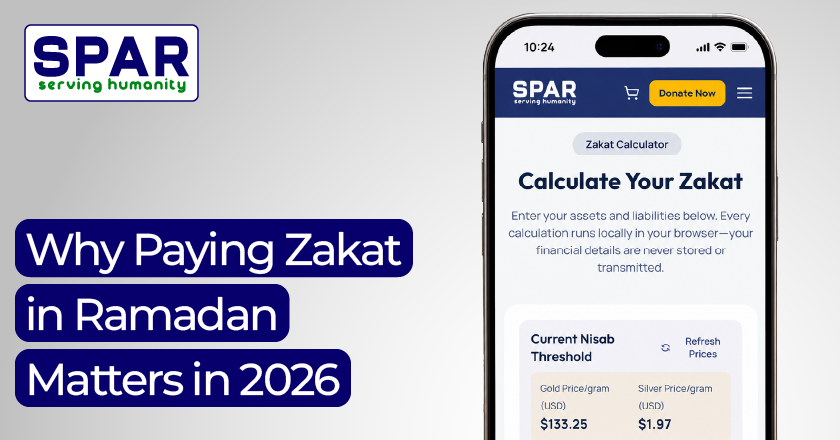
Ramadan is when most of the world’s Zakat moves. According to Pew Research, there are roughly 1.8 billion Muslims globally, and scholars estimate a large share of annual Zakat is transferred in this single month. That concentration of giving matters because families in need plan around it. Palestinian families, Somali communities, Rohingya refugees in Cox’s Bazar, and Bangladeshi families living below the poverty line all depend on Zakat reaching them before Eid. When donors delay or miscalculate, that gap hits hardest. You can see how SPAR puts Zakat to work through our Zakat programs at sparproject.org/zakat. Getting your payment right this Ramadan means more of your wealth reaches the people who need it most.
Paying Zakat in Ramadan: What Most People Don’t Know
The nisab threshold changes every year. It’s tied to the gold price, so it isn’t a fixed dollar number. As of 2026, 85 grams of gold equals roughly $4,900 to $5,100 USD depending on the market rate on your calculation date. Many Muslims use last year’s figure without checking, which means they may overpay or underpay. Ibn Qudama and later scholars like Imam al-Nawawi both confirmed that Zakat can be paid up to a year early without penalty, as long as the nisab is already met. So paying in Ramadan is fully valid even if your personal lunar year hasn’t ended. The key is to check the gold rate on the day you calculate, not the day you pay.
Does Paying Zakat in Ramadan Count If Your Hawl Hasn’t Ended?
Yes, it does. Scholars agree you can pay Zakat before your hawl ends, as long as your wealth already meets the nisab. This is called “ta’jeel al-Zakat,” or early payment. Imam al-Nawawi confirmed it in *Al-Majmu’*, and the majority of scholars from the Shafi’i, Hanafi, and Hanbali schools accept it. The only condition is that your wealth still meets nisab when the hawl actually ends. If it drops below nisab before then, the early payment counts as sadaqah, not Zakat. So paying in Ramadan is safe and valid for most donors.
What If Your Nisab Drops After You Pay Early?
Your Zakat won’t be voided. But it won’t count as Zakat either. It becomes a voluntary sadaqah, which still carries reward. If your wealth recovers before your hawl ends, scholars differ. The safer view, held by Ibn Qudama in *Al-Mughni*, is to recalculate and pay again if your wealth later crosses nisab at the hawl date. Most donors don’t face this issue. If your wealth is stable or growing, early payment in Ramadan is fully acceptable.
Does Your Zakat Year Reset When You Pay in Ramadan?
No. Your hawl is tied to the date your wealth first reached nisab, not the date you paid Zakat. Paying early in Ramadan doesn’t shift your anniversary date. Your next Zakat calculation still falls on the same lunar calendar date as before. Many donors assume paying in Ramadan resets the clock. It does not. Keep a note of your original nisab date to avoid confusion next year.
Common Mistakes When Paying Zakat in Ramadan
Most errors happen at the calculation stage, not the payment stage. The first mistake is using a fixed nisab figure from a previous year. The nisab changes with the gold price, so you must check the current rate on your calculation date. The second mistake is forgetting zakatable assets. Cash in savings is obvious, but many Muslims overlook trade goods, receivable debts others owe them, and agricultural produce. According to classical Hanafi fiqh, gold and silver jewellery held as an investment also qualifies. The third mistake is calculating on the wrong date, often the payment date instead of the hawl completion date.
Forgetting Debts and Receivables
If someone owes you money and you expect to get it back, it may count as a zakatable asset. Scholars differ on this. The stronger opinion in the Hanafi school treats expected debts as zakatable. The Shafi’i school is more cautious. If you’re unsure, include it. Overpaying Zakat is a gift to those in need. Underpaying is a shortfall in a religious duty. When in doubt, err on the side of more.
Using the Silver Nisab vs the Gold Nisab
The silver nisab (612.36 grams of silver) is worth far less than the gold nisab (85 grams of gold) in today’s market. As of 2026, silver nisab sits at roughly $650 USD, while gold nisab sits near $5,000 USD. Some scholars say use whichever helps more people, meaning the lower silver threshold. Others say gold nisab is more accurate for modern wealth. Many Hanafi scholars favour silver nisab to include more donors. Talk to a trusted scholar before choosing. The gap between the two is wide, and the right choice affects who qualifies to pay.
Who Needs Zakat the Most Right Now
Zakat reaches people in acute need, but the ones who depend on it most are those facing layered hardship, not just poverty. Palestinian families living through ongoing conflict have lost income, housing, and food access. Rohingya families in Cox’s Bazar live in temporary shelters with no legal right to work. Somali families in drought-affected areas face food shortages that return every dry season. Bangladeshi families below the poverty line, many of them day labourers with no savings, go months without stable income. Zakat, paid on time and distributed well, is often the only structured help these families receive before Eid.
Real change for these families doesn’t come from one large push. It comes
What You Need to Know Before Paying Zakat in Ramadan
Paying zakat in Ramadan is one of the most spiritually charged acts a Muslim can do. The reward multiplies, the need is real, and the structure is clear. Zakat al-Fitr must reach its recipients before Eid prayer. Regular zakat can be paid any time your wealth crosses the nisab threshold. If your lunar year completes in Ramadan, pay then. If not, don’t rush it at the cost of accuracy. UNICEF estimates over 300 million children live in extreme poverty. Many of them depend on zakat paid in this month.
Does the Type of Zakat Change When You Pay in Ramadan?
Yes, it does. Zakat al-Fitr is specific to Ramadan. It applies to every Muslim who has food beyond their daily needs. It must be paid before Eid prayer. Regular zakat follows your personal lunar year, called the hawl. The two types are separate. Paying one does not cover the other. Scholars agree on this point across all four main schools of thought.
Should You Rush Your Zakat Calculation to Pay in Ramadan?
No. Speed should not cost you accuracy. A wrong nisab or a missed asset leads to an invalid payment. Take the full time you need. Use the silver nisab if you follow Hanafi scholars. Use gold nisab if that is your school’s view. The act of paying in Ramadan is virtuous, but only if the amount is right. A correct zakat paid in Shawwal is worth more than a rushed one paid on the 27th night.
Ramadan brings out the best of the ummah. Muslims worldwide find themselves asking the same questions, working through the same calculations, and wanting to do it right. The families who receive zakat don’t know what month it was paid. They know that someone, somewhere, chose to act. At SPAR, that act connects to long-term programs across the regions where we work. The quiet, consistent effort is what changes lives over time. See how this work continues at SPAR.