
Zakat is the third pillar of Islam. It requires every eligible Muslim to give 2.5% of qualifying wealth each lunar year. Unlike Sadaqah (voluntary giving), Zakat is a fixed duty, not a choice. The Nisab threshold in 2026 sits at roughly $5,300 USD based on 85 grams of gold (World Gold Council pricing). It applies to adult Muslims of sound mind who hold wealth above Nisab for a full lunar year (hawl). One fact most guides skip: cash in a savings account you haven’t touched counts toward Nisab just as gold does.
How to Pay Zakat: Quick Answer
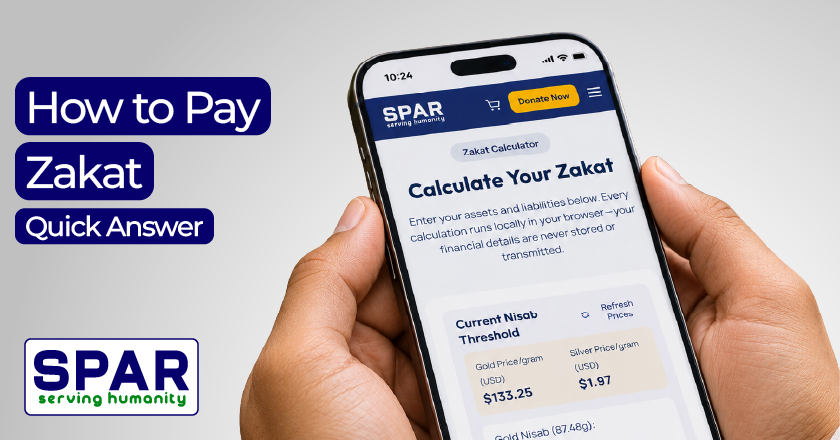
- What it is: Zakat is a mandatory 2.5% annual payment on qualifying Muslim wealth held above the Nisab threshold.
- Who it applies to: Adult Muslims of sound mind who own wealth above Nisab for one full lunar year (hawl).
- How much: 2.5% of total qualifying assets. On $10,000 in savings, that’s $250 USD.
- When: Once each lunar year, after wealth has been held above Nisab for a full 12 lunar months.
- The Nisab threshold (2026): About $5,300 USD based on 85g of gold, or about $390 USD based on 595g of silver.
- Main rule: Use the lower of gold or silver Nisab to avoid under-paying. Most scholars favour the silver standard for broader coverage.
- Most common mistake: Forgetting to include business inventory, receivable debts, and rental income in the Zakat calculation.
Why Paying Zakat Correctly Matters Right Now
Getting your Zakat right isn’t just a personal duty. It’s a lifeline for the world’s poorest families. The World Bank estimates about 700 million people live on less than $2.15 USD a day. Zakat, when paid and distributed properly, directly addresses that gap. Scholars like Imam al-Nawawi have long stressed that miscalculation doesn’t cancel the obligation; it carries over. That means errors compound year on year. At SPAR, our Zakat distribution work reaches families who depend on it as their main source of relief. Understanding your calculation isn’t a detail. It’s the whole point.
How to Pay Zakat: What Most People Don’t Know
Many Muslims calculate Zakat on cash alone. But the full scope is wider. Gold, silver, shares, business stock, money owed to you, and rental income all count. Pew Research estimates there are roughly 1.8 billion Muslims worldwide. If even a fraction miscalculates, the gap in Zakat funds reaching those in need runs into billions of dollars annually. The eight categories of Zakat recipients are named directly in the Quran (Surah At-Tawbah, 9:60). Knowing who can receive Zakat is as important as knowing how to calculate it. Many donors don’t realise they can give Zakat to families outside their own country, including Rohingya and Palestinian communities facing acute need.
Who Must Pay Zakat?
Zakat is only due on Muslims who are adults, sane, and free. They must also own wealth above the nisab for a full lunar year. Children and people with serious mental illness are exempt, according to classical scholars including Imam al-Nawawi. Debt matters too. If someone owes money, they can subtract that debt from their total before calculating. A person with $15,000 in savings but $14,000 in debt may fall below the nisab. This is a point many Muslims miss. Always calculate net wealth, not gross.
Does Zakat Apply to Business Owners?
Business owners must include their stock, cash reserves, and trade goods in the Zakat calculation. Fixed assets like machinery or buildings used in the business are exempt. But raw materials, finished stock, and cash held for trade all count. According to Islamic jurisprudence, a trader calculates the market value of stock on the day Zakat is due. If the total passes the nisab, Zakat is owed on the full amount. Many small business owners in Muslim-majority countries overlook this rule.
What About Debts and Loans?
Short-term debts reduce your Zakat base. Long-term debts, like a 20-year mortgage, are treated differently by scholars. Most classical scholars allow you to deduct only the current year’s repayment, not the full loan balance. If you lent money to someone else, you can include that as part of your Zakat-eligible wealth. This is because the debt is owed to you and is expected to return. Pew Research data shows that Muslim populations are growing fastest in regions with high poverty rates, where access to correct Zakat guidance is limited.
What Are the Eight Recipients of Zakat?
The Quran names eight groups who can receive Zakat in Surah At-Tawbah (9:60). They are: the poor, the destitute, those who collect and distribute Zakat, new Muslims who need support, people in debt, those working to free enslaved people, travellers who are stranded, and those fighting in the path of Allah. This list is fixed. Scholars agree it cannot be expanded. But it does cover a wide range of need. Rohingya families, Palestinian families, and Bangladeshi families living below the poverty line all fall within these categories.
Common Mistakes When Paying Zakat
Many Muslims pay Zakat on the wrong date each year. The Zakat year is lunar, not solar. A lunar year is about 11 days shorter than a solar one. If you fix your Zakat date to a solar calendar, you slowly drift out of sync. Over a decade, that gap adds up. Another common mistake is forgetting to include gold jewellery. Many women don’t count their jewellery as Zakat-eligible wealth. But the majority of scholars, including those from the Hanafi school, say gold jewellery above the nisab is subject to Zakat.
Forgetting Zakat on Shares and Investments
Shares in a company are Zakat-eligible. The scholar’s method is to look at the company’s underlying assets. If the company holds cash, stock, or receivables, Zakat applies to your proportional share of those assets. This can be hard to calculate. Many investors use a simpler method: pay 2.5% on the current market value of all shares held for a full year. According to AAOIFI standards (a major Islamic finance body), this simplified method is widely accepted for retail investors.
How Zakat Reaches Families in Need
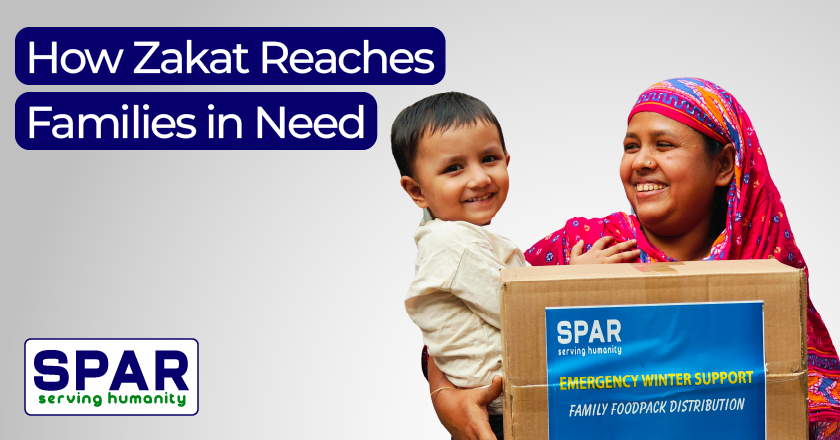
Zakat works best when it reaches people directly and fast. The families SPAR serves are often cut off from formal aid. They don’t have bank accounts. They don’t file requests. They rely on people in their local areas, and on charities with a long-term presence on the ground. Real change here is rarely sudden. It comes from small, steady efforts, season after season, from donors who treat Zakat not as a box to tick but as a transfer of right. The eight categories in the Quran are not abstract. They are real people, in real places, waiting.
What Paying Zakat Means in Practice
Zakat is not just a calculation. It is a transfer of right from those who have to those who need. The Quran names eight categories of people who qualify to receive it. Each one represents a real gap in the world. Once you know your nisab, your hawl, and your zakatable assets, the act of paying becomes simple. The hard part is staying consistent year after year. Pew Research estimates that Muslims globally hold billions in Zakatable wealth. Only a fraction reaches the eight categories. Closing that gap starts with every individual Muslim getting the calculation right and then acting on it.
Does the Calculation Ever Change?
Your nisab changes every year. Gold and silver prices shift. So does the value of cash and shares. Run your numbers fresh each time your hawl comes around. Do not rely on last year’s figure. A small change in the gold price can push your holdings above or below the threshold. Check a current gold price source and recalculate from scratch each year.
What Happens After You Pay?
Zakat only works when it reaches the right people fast. The families SPAR serves often have no bank accounts and no way to file requests. They depend on long-term charity presence in their area. Paying Zakat to a trusted charity with real field teams means it moves from your hand to the right category of recipient without delay. That is the full chain. Your calculation plus your action plus a reliable channel equals the obligation fulfilled.
Zakat is one of the clearest acts in Islam. The rules exist. The categories exist. The math is learnable. What stops most Muslims is not knowledge. It is delay. The ummah has practiced this for centuries because the need never stops. Palestinian families, Bangladeshi villages, Rohingya communities, and many others depend on the steady flow of Zakat from people who treat it as a duty, not a choice. SPAR’s field teams work inside those communities year after year. See how this work continues.