
Zakat is the annual giving of 2.5% of qualifying wealth by every adult Muslim whose savings exceed the nisab threshold, held for one full lunar year. Unlike Sadaqah, which is optional, Zakat is one of the Five Pillars of Islam and a binding duty. The nisab in 2026 equals about $436 USD, based on the gold nisab of 85 grams. It applies to Muslim adults who are sane, free, and financially above this threshold. Missing Zakat is not a lapse in generosity; classical scholars treat it as a major sin. Zakat’s redistribution force matters more than ever in a world where nearly 700 million people live on less than $2.15 a day, according to World Bank data.
Definition of Zakat With Hadith: Quick Answer
- What it is: Zakat is the obligatory annual payment of 2.5% of qualifying wealth, one of Islam’s Five Pillars, proven by the Quran and Hadith
- Who it applies to: Adult Muslims, of sound mind, who hold wealth above the nisab threshold for a full lunar year
- How much: 2.5% of total qualifying wealth above $436 USD (gold nisab, 85 g equivalent, 2026 estimate)
- Hadith source: The Prophet ﷺ defined Zakat’s categories in Sahih al-Bukhari (Book 24) and detailed livestock rules in Sahih Muslim (Book 12)
- Main rule: Wealth must be owned fully, above nisab, and held for one complete lunar year before Zakat becomes due
- Most common mistake: Many Muslims pay Zakat on gross income rather than net saved wealth held for a full year, which is incorrect.
Why the Definition of Zakat With Hadith Matters Right Now
The Prophet Muhammad ﷺ did not leave Zakat as a vague instruction. He spelled it out in precise terms. In Sahih al-Bukhari, Book 24, he described the categories of Zakat-eligible wealth and the rates for each. This level of detail is rare in religious law. It tells us Zakat was always meant to be exact, not approximate. Today, with over 1.8 billion Muslims worldwide (Pew Research, 2024), even a small rise in Zakat compliance could move billions of dollars toward families in need. You can see how that plays out in practice through SPAR’s ongoing Zakat programs. The hadith don’t just define a duty; they give us a system built to last.
Key Facts About the Definition of Zakat With Hadith
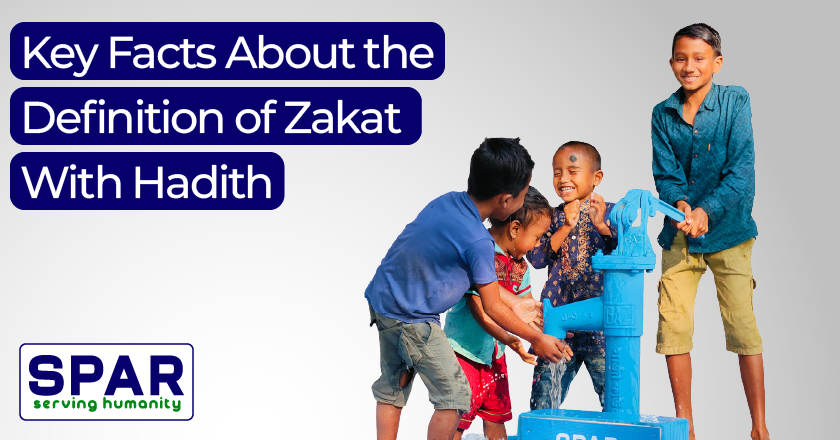
Scholars have drawn on two main hadith collections to shape Zakat law. Sahih al-Bukhari, Book 24, contains the Prophet’s ﷺ instructions on Zakat rates for gold, silver, and livestock. Sahih Muslim, Book 12, adds detail on camels, cattle, and grain thresholds. The classical scholar Imam al-Nawawi, in his commentary on Sahih Muslim, confirmed that the nisab for gold is 20 dinars (85 grams) and for silver it is 200 dirhams (595 grams). When the two nisab values conflict, most contemporary scholars recommend using the lower one, as this protects more recipients. The World Bank estimates the global Muslim Zakat pool at over $300 billion USD per year, most of it still uncollected.
What the Hadith Say About Who Must Pay Zakat
Zakat is not owed by everyone. The hadith set clear conditions. A person must be Muslim, free, and in full ownership of their wealth. That wealth must reach the nisab. And it must have been held for one full lunar year, called the hawl. Ibn Umar (may Allah be pleased with him) reported that the Prophet ﷺ said that no Zakat is due on wealth until a year has passed over it (reported in Abu Dawud). This law protects people whose wealth rises and falls. It also ensures Zakat captures stable, real wealth, not money that passed through someone’s hands for a week.
Does Debt Affect Who Must Pay?
Scholars say yes. If a person owes a debt that brings their net wealth below the nisab, they may not owe Zakat. Imam al-Nawawi confirmed this view in his work on Sahih Muslim. The logic is simple: Zakat is a duty on surplus, not on money already owed to others. This ruling matters for many families today. A person may look wealthy but carry heavy debts. The hadith, read alongside classical commentary, protect those people from a duty they cannot truly meet.
What About Children and Those With No Legal Capacity?
Most scholars hold that Zakat is due on a child’s wealth once it reaches the nisab. The guardian pays it on the child’s behalf. This comes from the broader principle in the hadith that Zakat follows the wealth, not the person’s age. Imam al-Nawawi noted this view clearly. Some scholars from the Hanafi school disagreed, arguing Zakat requires legal duty, which a child does not yet carry. But the majority position, based on hadith in Sahih al-Bukhari, holds that growing wealth must be purified, regardless of its owner’s age.
Common Mistakes Muslims Make When Calculating Zakat
Many Muslims pay too little or too much. The most common mistake is confusing gross wealth with zakatable wealth. Not all assets count. A home you live in is not zakatable. Your car for daily use is not zakatable. But gold, silver, cash, trade goods, and investments all count. A second mistake is using the solar year instead of the lunar year. The lunar year is about eleven days shorter. Over time, that gap shifts when your Zakat is due. Pew Research data shows that over 1.8 billion Muslims now live worldwide, but scholars estimate that a large share of them still calculate Zakat incorrectly.
Using the Wrong Nisab Value
There are two nisab values: one for gold (85 grams) and one for silver (595 grams). The silver nisab converts to a much lower dollar amount in today’s market. Using the gold nisab means fewer people qualify as payers. Using the silver nisab means more people must pay, and more families benefit. Most contemporary scholars recommend using the silver nisab. It follows the spirit of the hadith, which always aimed to protect the poor. This is not a minor point. This can mean the difference between owing Zakat and not owing it.
How Zakat Reaches the People: The Hadith Name
The Quran in Surah at-Tawbah (9:60) names eight groups who can receive Zakat. The hadith expand on how to reach them. The Prophet ﷺ appointed collectors called amil, local people who knew their communities. That model still works. Teams working in Bangladeshi, Somali, and Palestinian communities today use a similar approach: local staff who know who is truly in need. This kind of quiet, consistent fieldwork does not make headlines. But it is how wealth moves from those who have it to those the hadith intended to help, year after year.
What the Definition of Zakat with Hadith Means for You Today
The definition of Zakat with hadith is not an old debate. It is a live guide. The Prophet ﷺ set clear rules: 2.5% on wealth held for one lunar year, once nisab is met. Pew Research puts the global Muslim population at around 1.8 billion. Even a fraction failing to pay means billions in uncirculated wealth. The eight groups named in Surah at-Tawbah (9:60) still wait. Knowing the hadith is the first step. Acting on them is the second. Groups like SPAR work in the gap between those two steps.
How to Apply This Knowledge in Practice

Read the hadith, then check your numbers. Use the silver nisab where scholars allow it. Set a date each lunar year to calculate. Write it down. Many Muslims treat Zakat as a one-time task. But it repeats, by design, because the need repeats. The Prophet ﷺ built this into the faith on purpose. Teams across Bangladeshi, Palestinian, and Somali families see that need every day. The hadith were not written for a past world. They were written for this one.
Why Getting the Definition Right Matters
A wrong definition leads to wrong math. Wrong math means someone who owes Zakat does not pay. Or someone pays the wrong amount. Both harm the people the hadith named. Scholars like Imam al-Nawawi spent years refining these rules so the ummah could get this right. Their work survives because the stakes are real. The poor do not have the luxury of a miscalculation.
Zakat has endured for over fourteen centuries because it works. It moves wealth from those who hold it to those who need it, by law, by faith, and by choice. At SPAR, the work of reaching those eight Quranic groups goes on quietly, in Bangladeshi villages, among Rohingya families, and in Palestinian communities. No headlines. Just consistent effort rooted in the same hadith that guided the first collectors. See how this work continues at sparproject.org/our-work.