
Zakat in Ramadan is the same obligatory 2.5% annual payment that applies year-round, but Muslims widely choose Ramadan as their payment month because of its multiplied spiritual reward. It’s often confused with Zakat al-Fitr, a separate, smaller charity due only at the end of Ramadan. According to Pew Research Center, roughly 1.8 billion Muslims worldwide are bound by Zakat’s rules. Every adult Muslim who holds wealth above the nisab threshold for one full lunar year must pay. Missing the Ramadan window doesn’t cancel the obligation. The debt stays until paid.
Zakat in Ramadan: Quick Answer
- What it is: The annual 2.5% wealth purification due on savings held above the nisab for one full lunar year, commonly paid in Ramadan
- Who it applies to: Adult Muslims whose net wealth exceeds the nisab (about $450 USD in gold or $330 USD in silver) for 12 lunar months
- How much: 2.5% of total qualifying wealth above the nisab threshold, paid in USD or its equivalent
- When: Any time of year, but most Muslims pay during Ramadan for the extra spiritual reward it carries
- Main rule: Zakat is due on the lunar anniversary of your wealth first reaching nisab, not on Ramadan’s calendar date
- Key distinction: Zakat al-Fitr is a fixed per-person food amount (about $10 to $15 USD) due at Eid; Zakat is a percentage of total wealth
- Most common mistake: Treating Zakat as a Ramadan-only obligation. If your lunar anniversary falls outside Ramadan, delaying to Ramadan makes it overdue
Why Zakat in Ramadan Matters Right Now
Ramadan draws more Zakat than any other month, but that surge in giving masks a real gap. The United Nations estimates over 700 million people worldwide still live in extreme poverty, earning less than $2.15 USD a day. Zakat is one of Islam’s most direct tools for closing that gap. When the whole ummah pays in one concentrated window, entire families can move out of crisis fast. At SPAR, we’ve seen that timing and consistency matter. Long-term programs work best when funds arrive reliably each year, not in unpredictable waves. You can learn more about our Zakat distribution work and how we put these funds to work across the communities we serve. Paying on time, every lunar year, is what makes the system function.
Key Facts About Zakat in Ramadan Most People Don’t Know
Not every Muslim pays at the same rate or on the same date. The nisab, the minimum threshold before Zakat becomes due, has two accepted values: silver-based and gold-based. The silver nisab sits around $330 USD and the gold nisab around $450 USD. Scholars differ on which to use, though many recommend the silver nisab to include more wealth in the calculation, following the position of Imam Abu Hanifah. The World Bank’s 2024 poverty data shows the silver-based nisab catches a far broader base of eligible givers globally. Zakat applies to cash, savings, trade goods, and agricultural produce, but not to a primary home, daily-use items, or personal transport. Knowing what counts and what doesn’t is what separates a valid payment from a miscalculated one.
What Actually Counts as Zakat-Eligible Wealth?
Zakat in Ramadan applies only to specific types of wealth. Cash in a bank account counts. So do gold and silver, trade goods held for sale, and investment assets. But your home, your car for daily use, and your clothes do not count. Neither does furniture or tools you use for work. The rule is simple: productive or stored wealth gets calculated; personal-use items do not. Many Muslims over-count or under-count because they mix these two groups. A clean list before Ramadan helps you get it right the first time.
Does Debt Reduce Your Zakat?
Yes. Short-term debts you owe right now reduce your Zakat base. If you have $5,000 in savings but owe $2,000 in bills due this month, you calculate Zakat on $3,000, not $5,000. Long-term debts, like a mortgage, are handled differently. Most scholars say you only deduct the current monthly payment, not the full loan. This is where many people make errors. A simple spreadsheet with assets on one side and near-term debts on the other clears most of the confusion quickly.
What About Joint Accounts and Business Assets?
Business stock counts toward Zakat at trade value. So does money owed to you by others, if you expect to get it back. Joint accounts work on the principle of ownership. Each person pays Zakat on their own share. If you and a partner each own half a $20,000 account, you each calculate Zakat on $10,000. Business owners need to separate personal wealth from business debt carefully. According to AAOIFI Islamic finance standards, trade inventory is valued at market price on the day of calculation.
Common Mistakes People Make When Paying Zakat in Ramadan
Paying Zakat in Ramadan is good. But errors in the calculation can make a payment invalid. The most common mistake is using the wrong nisab. Some use the gold nisab to lower their threshold and avoid paying. Imam Abu Hanifah’s position favors the silver nisab, which sets the bar lower and includes more givers. A second common error is forgetting the hawl, the full lunar year of ownership. If you came into wealth two months ago, Zakat on that amount is not due yet. Precision here is an act of worship, not just accounting.
Who Must Receive Zakat? The Eight Categories Explained
The Quran names exactly eight groups who can receive Zakat. Surah At-Tawbah (9:60) lists them: the poor, the destitute, those who collect and distribute Zakat, those whose hearts are being drawn to Islam, people in debt, those in bondage, travelers who are stranded, and those working in the path of God. Not every group applies in every context today. But the poor and the destitute, the first two categories, are almost always present. According to the World Bank, about 700 million people still live on under $2.15 a day. Zakat in Ramadan exists, in part, to move wealth toward exactly these people.
Does Zakat Go to Non-Muslims?
This is a real question many donors ask. The majority scholarly position holds that Zakat goes to Muslims in the eight categories. Sadaqah, voluntary charity, has no such limit and can go to anyone in need. Some scholars permit giving Zakat to non-Muslims under the “those whose hearts are inclined” category. But for general distribution, most Zakat is directed toward Muslim families in need. This distinction matters when you choose how to direct your funds.
How Consistent Giving Changes More Than a Single Large Gift
One gift in Ramadan can feed a family for a week. But a family that gets help every Ramadan, year after year, builds real stability. They plan ahead. They budget better. Children stay in school because the annual shortfall gets covered. UNICEF data shows that consistent cash support, not one-off transfers, leads to lasting gains in child health and school attendance. The teams doing this work across Bangladeshi, Somali, and Pakistani communities don’t make headlines. They show up, year after year, season after season. That quiet, sustained commitment is what turns a gift into a change.
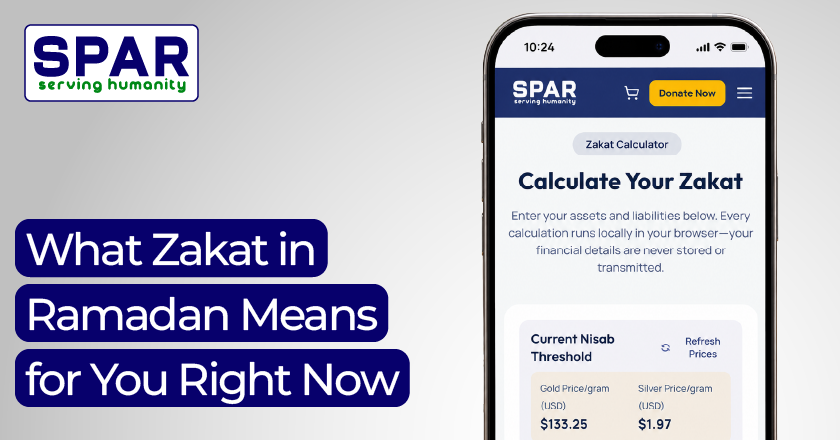
What Zakat in Ramadan Means for You Right Now
Zakat in Ramadan is one of the most powerful acts a Muslim can take. The rewards multiply. The need is real and urgent. Scholars widely agree that Ramadan is the best time to fulfill your Zakat. UNICEF estimates over 333 million children live in extreme poverty worldwide. That gap is real. Your Zakat fills part of it. The eight categories defined in Surah At-Tawbah (9:60) make the rules clear. You know who qualifies. You know when to give. The only step left is the one you take.
What Happens When Zakat Reaches the Right Hands
Zakat does more than cover a single bill. It gives a family room to breathe. When a mother in a Bangladeshi village gets timely support, she can feed her children and keep them in school. The World Bank links regular cash support to lasting drops in child poverty rates. One well-placed gift, given at the right time, shifts what a family can plan for next year.
The Long-Term Picture for Consistent Givers
Many Muslims give Zakat once and forget. But families who receive support year after year build real stability. UNICEF data confirms that consistent transfers, not one-off gifts, lead to lasting gains in child health and school attendance. When you give Zakat in Ramadan every year, you become part of that long chain. The family on the other end starts to plan around it. That changes lives in ways one gift cannot.
Behind every family that moves out of poverty is a quiet, steady stream of care. No headlines. No fanfare. Just consistent support, year after year, from Muslims who chose to stay involved. At SPAR, that quiet commitment shapes all the work we do, from Bangladeshi villages to Gazarian families and Somali communities in need. The work does not stop when Ramadan ends. It just carries on. See how this work continues.