
A mosque repair donation is a voluntary or obligatory contribution made to restore, maintain, or rebuild a damaged house of Allah. It differs from general sadaqah because the mosque itself is a communal asset. Every Muslim in a community shares responsibility for its upkeep. According to the World Bank, physical infrastructure decay affects hundreds of millions of people across low-income countries each year. That includes mosques in many Muslim-majority regions.
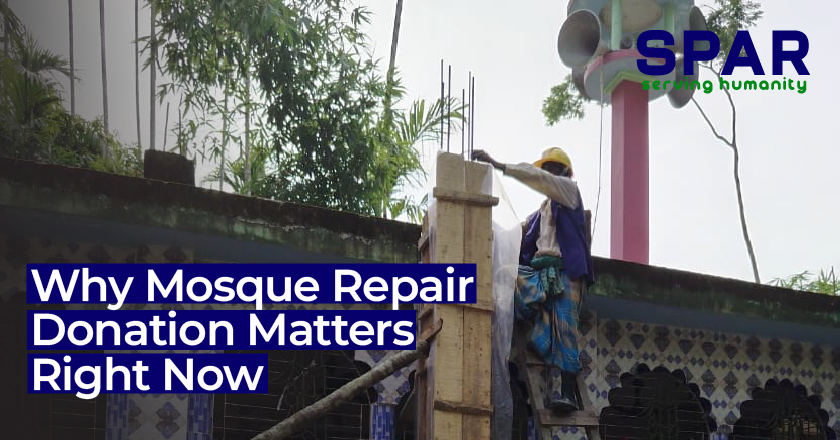
Why Mosque Repair Donation Matters Right Now
Mosques aren’t just prayer spaces. They’re schools, shelters, and community anchors. When a roof collapses or a wall cracks, an entire neighbourhood loses its gathering point. The United Nations estimates that climate-related disasters damaged over 50,000 community structures globally in 2024 alone. Many were places of worship. In Bangladeshi, Somali, and Palestinian communities, mosques often serve families who have no other public space. That’s why SPAR’s mosque restoration work focuses on long-term structural repair, not just quick fixes. A repaired mosque doesn’t just shelter prayer. It holds a community together.
Key Facts About Mosque Repair Donation Most People Don’t Know
Mosque repair carries specific weight in Islamic jurisprudence. Imam al-Nawawi clarified that maintaining a masjid falls under fard kifayah, a collective duty. If no one fulfils it, the whole community bears the sin. The Prophet Muhammad (peace be upon him) said: “Whoever builds a mosque for Allah, Allah will build for him a house in Paradise” (Sahih al-Bukhari, Book 8, Hadith 441). Scholars extend this to repair and restoration, not just new construction. Pew Research data shows that Muslim communities in lower-income regions often spend less than $200 USD annually on mosque maintenance. That gap leaves structures vulnerable to flood, age, and neglect.
What Types of Mosque Repair Does a Donation Actually Cover?
A mosque repair donation can cover far more than most donors expect. Structural work tops the list: cracked foundations, flood-damaged walls, and collapsed roofs all need skilled labour and proper materials. But repairs also include waterproofing, electrical rewiring, ablution area restoration, and safe flooring. According to UNICEF’s infrastructure assessments in conflict-affected regions, water damage alone causes structural failure in community buildings within five to seven years if left untreated. A mosque in a low-income community rarely fails all at once. It weakens slowly, season by season, until one monsoon or one tremor ends it.
Structural vs. Non-Structural Repairs
Not all mosque damage looks the same. Structural repairs fix load-bearing elements: walls, columns, beams, and foundations. These need engineers and licensed contractors. Non-structural repairs cover everything else: plasterwork, paint, drainage, lighting, and sanitation. Both matter equally. A mosque with a solid roof but broken wudu taps can’t serve its community properly. SPAR’s restoration work addresses both layers. The goal is a building that functions fully, not one that simply stands.
Why Flood Damage Is the Hardest to Reverse
Flood damage is quiet at first. Water seeps into brick, weakens mortar, and corrodes metal fittings. By the time the damage shows on the surface, it’s already deep inside the structure. Bangladeshi communities face this cycle annually. The monsoon season pushes groundwater into mosque foundations across low-lying districts. Repairs made without proper waterproofing fail within two or three seasons. Sustained, expert-led restoration breaks that cycle. It costs more upfront but far less over time.
Common Misconceptions About Mosque Repair Donation
Many Muslims assume mosque repair donation is only valid for grand, historic mosques. That’s not accurate. Islamic legal scholars, including Imam al-Nawawi and Ibn Qudama, both confirm that the reward for maintaining a mosque applies to any place established for congregational prayer, large or small. Pew Research data shows that over 60% of mosques in low-income Muslim-majority countries operate without a dedicated maintenance budget. A small neighbourhood masjid with a leaking roof and fifty worshippers needs support just as much as a landmark structure. Size doesn’t determine sanctity.
“Someone Else Will Handle It”
This assumption is one of the most damaging in Muslim communities. Because mosque upkeep falls under fard kifayah, a collective obligation, it’s easy to assume another donor has covered it. But collective duties fail precisely when everyone assumes this. Scholars note that when no individual takes personal responsibility, the obligation remains unfulfilled for the entire community. The reward for stepping forward belongs to those who act. The gap belongs to those who wait.
Who Is Most Affected When Mosques Fall Into Disrepair?
Women, children, and elderly worshippers suffer most when a mosque deteriorates. Broken flooring injures older worshippers. Unsafe roofs pose a risk to children attending Quran classes. Women’s prayer sections, often smaller and less visible, tend to receive repairs last. According to the World Bank’s 2023 infrastructure report, community buildings in low-income regions lose function fastest in their secondary spaces, exactly the spaces women and children use most. Mosques in Bangladeshi flood-prone regions, Somali displaced settlements, and Rohingya refugee communities all show this pattern. The congregation shrinks. The classes stop. The community frays.
How Small, Sustained Efforts Outperform One-Time Fixes
A single large donation can rebuild a mosque. But without follow-up, the same building deteriorates again inside a decade. Sustained giving, even at modest levels, changes this. SPAR’s approach to mosque restoration prioritises maintenance plans alongside initial repairs. A family contributing $30 a year toward ongoing upkeep does more long-term good than a single $200 gift with no follow-through. The communities we serve don’t need rescue once. They need consistent, quiet support, year after year. Real change here rarely arrives suddenly. It comes from people who decide this is worth their continued attention, and keep deciding that, season after season.
What Every Muslim Should Know About Mosque Repair Donation
Mosque repair donation is one of the most overlooked forms of sadaqah jariyah. Yet its impact spreads far beyond the building itself. According to the World Bank’s 2023 infrastructure report, community structures in low-income regions deteriorate twice as fast without regular maintenance, making sustained giving more valuable than a single large gift. When a mosque stays functional, Quran classes continue, funeral services run without delay, and women’s prayer spaces remain open. SPAR’s long-term programs reflect this thinking. Quiet, consistent support keeps mosques serving their communities for generations.
Why Ongoing Maintenance Matters More Than Restoration
One-time restoration fixes visible damage. But walls crack again. Roofs wear down. Floors break apart. Ongoing maintenance closes that gap. UNICEF’s community infrastructure guidelines confirm that buildings maintained annually last three to four times longer than those repaired only after failure. A community that funds repairs every year keeps its mosque functional at a fraction of the cost. Small, steady contributions make that possible.
How Sustained Giving Shapes Community Stability
A mosque in a flood-prone region needs more than one repair cycle. It needs a community behind it, season after season. Bangladeshi families facing annual monsoon damage understand this well. SPAR’s approach ties initial repairs to ongoing maintenance plans, so the same building does not fall back into disrepair within a decade. Families who contribute $30 a year toward upkeep do more long-term good than those who give once and move on.
Behind every repaired mosque is a long line of people who stayed involved after the moment passed. At SPAR, that quiet commitment shapes how we work. The mosques we help restore keep serving their communities because someone decided the work was worth returning to, year after year.