
A mosque ablution facility is a dedicated washing area where Muslims perform wudu, the ritual purification required before prayer. It’s not a convenience. Islamic law makes wudu a condition for salah to be valid, so without a proper facility, congregational prayer breaks down. Scholars estimate Muslims pray five times daily, meaning a mosque’s ablution area serves its community hundreds of times each week. Every worshipper depends on it.
Why a Mosque Ablution Facility Matters Right Now
Clean, accessible ablution spaces sit at the heart of Muslim community life. According to the World Health Organization, about 2 billion people worldwide still lack access to basic handwashing facilities at home. For many Muslims in low-income communities, the mosque’s wudu area is the most reliable clean water point they use each day. It’s not only a religious space. It’s a public health resource. Poorly built or poorly maintained facilities spread infection and push worshippers away from the masjid. SPAR’s ablution and mosque infrastructure work focuses on this gap directly, because a functioning wudu space keeps a community praying together. When it fails, the congregation feels it fast.
Key Facts About Mosque Ablution Facilities
Ablution facilities range from simple outdoor tap rows to fully tiled indoor wash rooms with separate male and female sections. Islamic jurisprudence, as detailed by scholars including Imam al-Nawawi in *al-Majmu*, requires that wudu water be clean, uncontaminated, and free-flowing. A facility that exposes worshippers to shared standing water doesn’t meet this standard. Pew Research estimates 1.8 billion Muslims globally observe regular prayer, which makes functional ablution infrastructure one of the most-used religious facilities on earth. In lower-income regions, the cost of building a basic wudu facility can start at around $800 USD. Without external support, many smaller mosques simply can’t afford it.
What Are the Main Types of Mosque Ablution Facilities?
Mosque ablution facilities fall into three broad types: outdoor tap rows, semi-enclosed wash stations, and fully indoor wudu rooms. Outdoor rows are the simplest and cheapest to build. They work in dry climates but fail quickly in cold or rainy regions. Semi-enclosed stations add a roof and basic drainage. Indoor wudu rooms offer the most complete setup, with separate male and female sections, tiled floors, seating for the elderly, and controlled drainage. According to WHO sanitation standards, any shared wash facility needs proper drainage and hand-washing access to prevent infection. The type a mosque can build usually depends on space and budget.
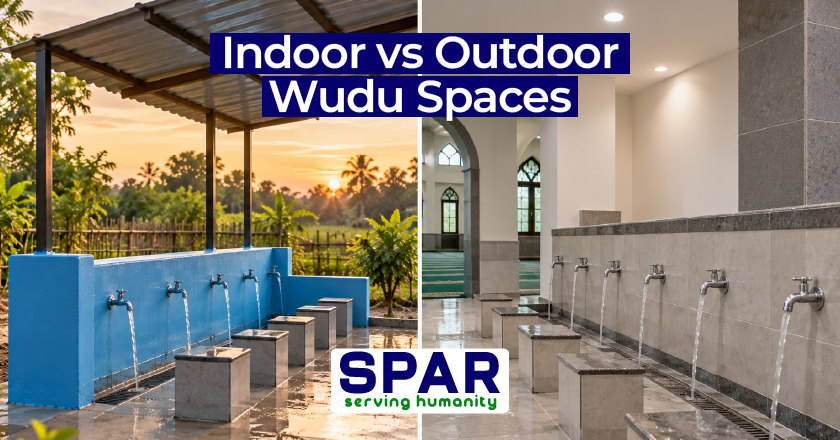
Indoor vs Outdoor Wudu Spaces
Indoor wudu rooms give worshippers privacy, warmth, and cleaner conditions year-round. They cost more to build, but they last longer and serve more people. Outdoor tap rows are common across lower-income communities, where building costs must stay low. But standing water near outdoor stations is a real health risk. UNICEF notes that poor drainage at shared wash points raises the chance of waterborne illness. Communities often start with outdoor stations and upgrade over time as mosque funds grow.
Facilities for Elderly and Disabled Worshippers
Many older wudu spaces don’t account for worshippers who can’t stand for long. Benches, lower taps, and non-slip tiles change this. Islamic jurisprudence, as detailed by Imam al-Nawawi, confirms that tayammum (dry ablution) is valid when water use causes harm. But a well-built facility removes the need for that workaround. Simple design changes, like grab rails and seated wash stations, let elderly and disabled Muslims perform wudu with dignity. These additions don’t raise costs by much, but they expand who the space serves.
Common Misconceptions About Mosque Ablution Facilities
Many people assume any water source near a mosque is enough for valid wudu. This isn’t accurate. Islamic law requires that water be clean, free-flowing, and free of impurity. A shared basin where water pools and sits doesn’t meet that standard. Another common assumption is that wudu facilities are only a minor part of mosque infrastructure. In practice, a broken or dirty wudu space stops worshippers from praying at all. According to Pew Research, Muslims pray up to five times daily. That means a mosque ablution facility sees more use than almost any other part of the building, every single day.
Who Is Most Affected by Poor Ablution Infrastructure?
Women, children, and elderly worshippers carry the heaviest cost of poor wudu facilities. In many mosques across Bangladeshi communities and displaced Rohingya settlements, women’s wudu areas are built as an afterthought. They’re smaller, less maintained, and harder to reach. This pushes women away from congregational prayer. Children who attend madrasa or Jumu’ah with their families need safe, low-height facilities too. The elderly need seating and slip-proof surfaces. When a mosque ablution facility ignores these groups, it quietly excludes a large part of the congregation. Change here is rarely sudden. It comes from small, sustained efforts, season after season, by people who understand what a clean wudu space actually means.
How Does a Mosque Ablution Facility Affect Community Health?
A mosque ablution facility is a shared wash point used many times daily. That makes it a key infection control site. The World Health Organization links poor hand-washing facilities directly to the spread of diarrheal disease, respiratory illness, and skin infections. In communities where access to clean water at home is limited, the mosque wudu space may be one of the only reliable wash points available. When it drains well, stays clean, and runs fresh water, it protects the whole neighborhood. When it fails, the health risk spreads beyond the mosque walls.
What Every Mosque Should Know About Its Ablution Facility
A mosque ablution facility is not just a washroom. It is a health site, a ritual space, and a daily lifeline for hundreds of people. WHO data confirms that shared wash points with poor drainage raise the risk of diarrheal illness and skin infections across whole neighborhoods. When wudu spaces are built well, maintained well, and designed for everyone, they protect the congregation and the wider community. This is the quiet, practical side of mosque care that matters long after any renovation fund closes.
Who Bears Responsibility for Upkeep?
Mosque committees, local imams, and congregation members share this responsibility. No single group can carry it alone. Committees set the budget and the maintenance schedule. Imams frame the religious duty. And congregation members raise concerns when something breaks or a section of the facility is left unclean. When all three work together, small problems get fixed before they become large ones. The strongest wudu facilities are managed by committees that treat them as a community health matter, not just a building concern.
What Does Good Design Actually Look Like?
Good design starts with drainage. Water should clear fast, with no pooling on the floor. Seating for the elderly, lower tap heights for children, and separate sections for women are not extras. They are part of building a space the whole congregation can use. Slip-resistant flooring matters. Ventilation matters. So does lighting. A well-designed mosque ablution facility costs more upfront. But it costs far less over time in repairs, deep cleaning, and health problems that come from a poorly maintained space.
Behind every clean wudu space is a group of people who chose to stay involved long after the first push ended. The work is not dramatic. It is schedules, checkups, small repairs, and conversations between neighbors who care about the same things. SPAR’s work across the communities we serve reflects this same quiet commitment, built over years rather than weeks. See how this work continues.