
Zakat is one of Islam’s five pillars. It requires every adult Muslim who owns wealth above the nisab threshold to give 2.5% of that wealth annually to one of eight eligible categories set by the Quran in Surah At-Tawbah (9:60). It’s not a voluntary act of charity. Zakat is a financial obligation calculated on savings, gold, silver, and trade goods held for one full lunar year (hawl). The nisab equals 85 grams of gold, worth about $7,650 USD at mid-2025 gold prices, a figure most guides never clearly state. Every sane, free, adult Muslim whose net zakatable wealth clears that threshold must pay. Miss the hawl, and your calculation resets. In 2025, rising gold prices have pushed the nisab higher than many Muslims expect, so recalculating before Ramadan matters more than ever.
How Do I Pay Zakat: Quick Answer
- What it is: Zakat is a mandatory 2.5% annual payment on qualifying Muslim wealth, not an optional donation.
- Who it applies to: Adult, sane Muslims whose net zakatable wealth stays above nisab for one full lunar year.
- How much: 2.5% of total zakatable assets. On $10,000 USD saved for a full year, that’s $250 USD.
- When: Once every lunar year (hawl) after wealth has stayed above nisab for 12 consecutive months.
- Nisab value (mid-2025): About $7,650 USD based on 85 grams of gold, per standard scholarly calculation.
- 8 eligible recipients: The poor, the needy, Zakat collectors, new Muslims, those in debt, slaves (historical), travelers, and those in God’s cause, per Quran 9:60.
- Most common mistake: Calculating Zakat on gross income like a tax, rather than on net savings held above nisab for a full hawl.
Why Paying Zakat Correctly Matters Right Now
Zakat moves an estimated $300 billion to $1 trillion USD globally each year, according to a World Bank working paper on Islamic finance, making it one of the largest annual wealth transfers on the planet. But scholars and researchers agree that a large portion never reaches the eight Quranic categories because donors miscalculate their base or choose recipients outside those categories. In 2025, with displaced Rohingya communities, Palestinian families, and Bangladeshi households all facing acute need, the stakes of getting this right are high. Wealth given outside the proper categories doesn’t count as Zakat; it counts as sadaqah. That distinction changes your spiritual obligation entirely. You can learn how SPAR channels verified Zakat funds through our Zakat distribution program to families who meet the Quranic criteria.
Key Facts About Zakat Most Donors Don’t Know
The Quran names exactly eight recipients for Zakat in one verse: Surah At-Tawbah 9:60. That list is closed. No scholar of the four major madhabs has added a ninth category. Yet Pew Research data on global Muslim charitable giving shows that many donors treat Zakat like general charity, giving it to mosques, schools, or community centers that don’t always serve the eight designated groups. Zakat on gold applies from the first gram above 85g, not just to round numbers of jewelry. Business inventory counts in full. Debts you owe get subtracted before you calculate. And Zakat al-Fitr, a separate per-person payment due before Eid al-Fitr, is not the same as annual Zakat al-Mal. Confusing the two is among the most common errors of classical scholars like Imam.
Key Facts About Zakat Most Donors Don’t Know
Imam An-Nawawi noted in *Al-Majmu* that confusing Zakat al-Mal with Zakat al-Fitr is among the most repeated errors in Islamic practice. They are two separate obligations. Zakat al-Fitr is a fixed per-person food payment due before Eid al-Fitr prayer. Zakat al-Mal is your annual wealth purification. Paying one does not cover the other. Zakat on gold applies from the first gram above 85 grams, not just on round jewelry. Business inventory counts at full market value. Debts you owe get subtracted before you calculate your total nisab.
Does Mosque Giving Count as Zakat?
A mosque is not one of the eight Quranic categories in Surah At-Tawbah 9:60. So giving to a mosque does not count as Zakat unless the mosque directly serves one of the eight groups, such as distributing to the poor. Many Muslims assume all Islamic giving is equal. But Zakat has specific rules. Sadaqah covers voluntary giving to mosques, schools, and general community projects. If you want your Zakat to count, it must reach a qualifying recipient. A scholar or verified charity can help confirm the correct channel.
Does Zakat Apply to Debts You Owe?
Yes. Debts reduce your Zakatable wealth. If you have $10,000 in savings but owe $3,000, your net Zakatable amount is $7,000. Most classical scholars agree on this. But not all debts qualify. Short-term debts due within the year are deducted. Long-term loans, like a mortgage, are handled differently across the four major madhabs. Ibn Uthaymeen held that only the current installment due is deductible, not the full loan balance. Check with a scholar if your debt situation is complex before you finalize your Zakat amount.
How to Pay Zakat: A Step-by-Step Process
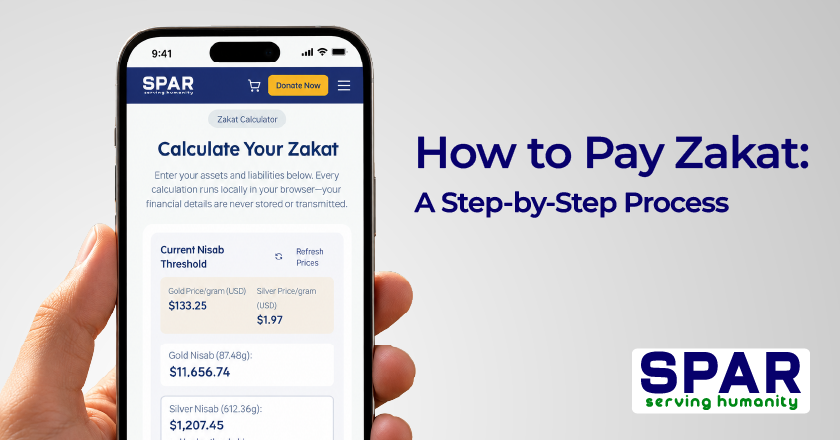
Paying Zakat follows a clear sequence. First, identify your Zakat anniversary date. This is usually the Islamic month you first owned nisab-level wealth. Second, list all Zakatable assets: cash, gold, silver, trade goods, and investment shares. Third, subtract any debts due within that year. Fourth, check if the remaining total exceeds the nisab threshold. According to the World Gold Council, gold nisab fluctuates with market prices, so verify the current rate before you calculate. Fifth, multiply the net total by 2.5%. Sixth, distribute that amount to one or more of the eight eligible categories.
What Counts as a Zakatable Asset?
Cash in bank accounts counts. Physical gold above 85 grams counts. Silver above 595 grams counts. Business stock counts at current sale value. Shares in a company count based on the underlying assets of that company. A home you live in does not count. A car for personal use does not count. Pension funds are debated among scholars. Ibn Baz held that any wealth you can access and control is subject to Zakat. If you are unsure whether an asset qualifies, apply the rule of access: can you use or sell it freely today?
Who Receives Zakat, and How Do They Qualify?
The eight recipients come directly from the Quran. They are the poor, the destitute, Zakat collectors, those whose hearts are being reconciled to Islam, people in bondage, those in debt, those striving in the way of Allah, and travelers in need. Each category has conditions. “The poor” means someone whose income falls below their basic needs. “Those in debt” means someone whose debts exceed their assets. Families across Bangladeshi, Palestinian, Somali, and Rohingya communities often fall into multiple categories at once. Real change in these communities comes slowly. It takes quiet, consistent support from people far from the crisis, season after season.
What You Now Know About Paying Zakat
Zakat has clear rules. You calculate 2.5% of qualifying wealth held above the Nisab for one full lunar year. Gold above 85 grams counts. Silver above 595 grams also counts. Cash, savings, and business assets count too. The Nisab in USD changes with gold and silver spot prices, so check it before you calculate. The eight Quranic categories of recipients are fixed. Your Zakat reaches the poor, the destitute, those crushed by debt, and others in genuine need. Knowing the rules removes the doubt. Acting on them is where the obligation becomes real.
Many Muslims carry Zakat on their conscience for months. They’re not avoiding it. They’re unsure they’ve done it right. The rules in this article give you a working framework. Apply them. If a specific asset still feels unclear, ask a qualified scholar. The obligation doesn’t go away with hesitation. It lifts when you act.
What If You Made a Mistake in Past Years?
You can correct missed Zakat. Scholars across all four major schools agree on this point. Calculate what you owed in the missed year, using the Nisab for that period. Then pay it now. Ibn Uthaymeen held that a Muslim who missed Zakat out of ignorance should pay the outstanding amount without penalty. Negligence is different from ignorance, but repentance combined with payment clears the obligation in either case.
Does Paying Zakat Early Count?
Yes, paying Zakat before the lunar year completes is valid under the Hanbali, Shafi’i, and Hanafi schools. Imam al-Nawawi confirmed this in Al-Majmu. The Nisab must already be met before early payment is valid. If your wealth drops below Nisab before the year ends, you recalculate. Paying early can bring Zakat to communities in urgent need before seasonal hardship peaks. It does not reduce what you owe. It simply moves the timeline forward.
Paying Zakat is one of the clearest acts in Islam. The calculation is fixed. The recipients are named. The threshold is known. What remains is the intention and the follow-through. Communities across Bangladesh, Somalia, Palestine, and beyond wait for what the ummah chooses to release each year. That release isn’t symbolic. It reaches families. It changes what they eat, where they sleep, and whether their children go to school. See how SPAR’s programs work across the regions we serve.