
A Zakat fund is a pool of collected Zakat wealth distributed to eight specific categories defined in the Quran (Surah At-Tawbah 9:60). It’s not the same as Sadaqah, which is voluntary. The nisab threshold, confirmed by Islamic scholars, sits at the value of 87.48 grams of gold or 612.36 grams of silver—roughly $5,800 USD at mid-2025 gold prices, making the silver nisab the more accessible calculation for most donors. Adult Muslims who own wealth above the nisab for one full lunar year (the hawl) must pay 2.5% as Zakat. One critical rule: Zakat fund distributions cannot go to non-eligible recipients, even in urgent need. In 2025, global Zakat giving is estimated at 300–600 billion USD annually, yet distribution gaps remain wide across Muslim-majority regions.
Zakat Fund: Quick Answer
- What it is: A structured pool of Zakat wealth distributed only to the eight Quranic categories in Surah At-Tawbah 9:60
- Who it applies to: Adult Muslims who own wealth above the nisab threshold for one full lunar year (hawl)
- How much: 2.5% of total qualifying wealth, calculated after one full lunar year of ownership
- Nisab in USD: About $5,800 USD based on gold (87.48 g); or about $430 USD based on silver (612.36 g) at mid-2025 prices
- Main rule: Zakat can’t go to non-eligible recipients, even for emergencies—Sadaqah fills that gap
- Most common mistake: Donors count only cash savings, missing gold, silver, trade goods, and business inventory in their Zakat calculation
- When: Due once per lunar year, calculated on the anniversary of reaching the nisab
Why a Zakat Fund Matters More Than Ever Right Now
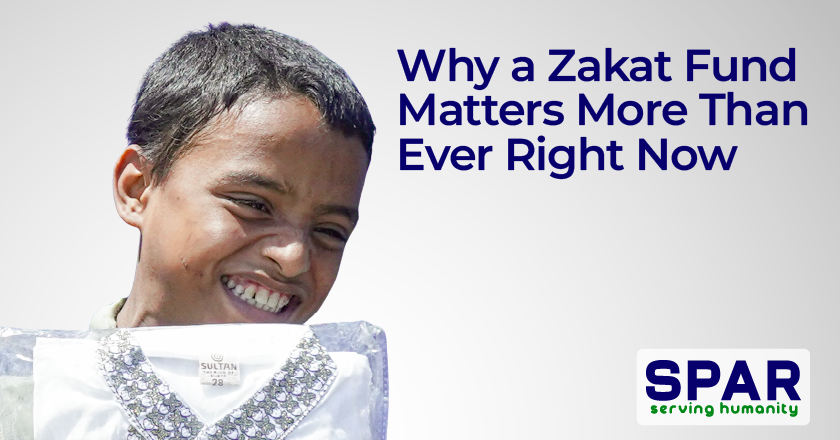
The world’s poorest communities don’t lack people willing to help. They lack consistent, structured giving. Zakat funds change that. The World Bank estimates that over 700 million people still live on less than $2.15 USD a day—and a large share of them live in Muslim-majority regions where a well-run Zakat fund is often the first line of relief. Unlike one-off charity, Zakat creates a predictable flow of wealth toward the most vulnerable. Bangladeshi families, Rohingya communities, Somali villages, and Palestinian families in besieged areas all depend on this structured giving cycle. You can see how SPAR puts Zakat to work through our Zakat distribution program. The nisab rule ensures that only those with real surplus give, and the hawl rule ensures consistent annual cycles. That’s what makes Zakat a system, not just a sentiment.
Key Facts About the Zakat Fund Most Donors Don’t Know
Scholars have debated whether to use the gold or silver nisab for centuries. Today, most contemporary scholars recommend the silver nisab because it includes more donors and reaches more recipients in need. At mid-2025 prices, the silver nisab sits at about $430 USD, while the gold nisab reaches about $5,800 USD. That gap matters. A donor with $3,000 USD in savings owes Zakat under the silver standard but nothing under gold. According to research cited by the United Nations Development Programme, the total annual Zakat potential in Muslim-majority countries exceeds $300 billion USD. But collection rates remain low. Many scholars, including Ibn Baz and Ibn Uthaymeen, emphasised that Zakat fund managers carry a legal trust (amanah) over every dollar collected. Misuse or delay in distribution is not a minor error. It’s a violation of that trust.
Who Qualifies to Receive Zakat Fund Distributions?
Islamic law names eight categories of Zakat recipients. The Quran lists them in Surah At-Tawbah (9:60): the poor, the destitute, those who collect and distribute Zakat, new Muslims whose hearts need support, those in debt, those working in the path of Allah, and travelers cut off from resources. Scholars classify the first two, the poor (fuqara) and the destitute (masakin), as the primary recipients in most contexts. According to UNICEF, over 700 million people worldwide live below the extreme poverty line. Zakat fund managers must match these categories carefully. Giving to the wrong recipient doesn’t count.
The Difference Between Fuqara and Masakin
These two groups sound similar. But scholars draw a real line. The fuqara have some income but not enough to meet basic needs. The masakin have nothing at all. Imam al-Nawawi, in his commentary on Sahih Muslim, explains that the masakin are often in greater need. So a Zakat fund that serves both groups must assess each family’s actual situation. A simple income check isn’t enough. Field teams need to understand debts, household size, and local costs before they classify anyone.
What About Those in Debt?
Gharimun, those crushed by debt, form one of the most overlooked Zakat categories. A person may own assets but owe more than they hold. Under Islamic law, that person can receive Zakat to clear a debt that arose from genuine need, not reckless spending. This matters in communities where informal loans carry high interest and trap families in cycles they can’t exit alone. The Zakat fund reaches people who look stable from the outside but are financially broken underneath.
Common Mistakes When Setting Up a Zakat Fund
Most Zakat errors happen before a single dollar moves. The three most common mistakes are poor recipient verification, weak amanah structures, and delayed distribution. A Zakat fund built without a clear intake process will misplace funds. It has happened at the institutional level, and it happens at the individual level too. The Prophet Muhammad (peace be upon him) warned against giving Zakat to someone who doesn’t need it. Sahih al-Bukhari records that a man gave charity without checking and accidentally gave to a rich man, a thief, and an adulteress on three nights. The moral is clear: intention alone isn’t enough. Due diligence is part of the ibadah.
Delaying Distribution Without a Valid Reason
Scholars agree that Zakat must move quickly once it’s due. There’s no fixed deadline in a number of days, but holding Zakat beyond a reasonable time without cause is condemned. Ibn Uthaymeen wrote that a Zakat fund administrator who holds funds for more than a year without distribution has likely breached the amanah. The money belongs to the recipients, not the fund. This is why SPAR’s approach treats timely delivery as a non-negotiable standard, not a preference.
How a Well-Managed Zakat Fund Creates Long-Term Change
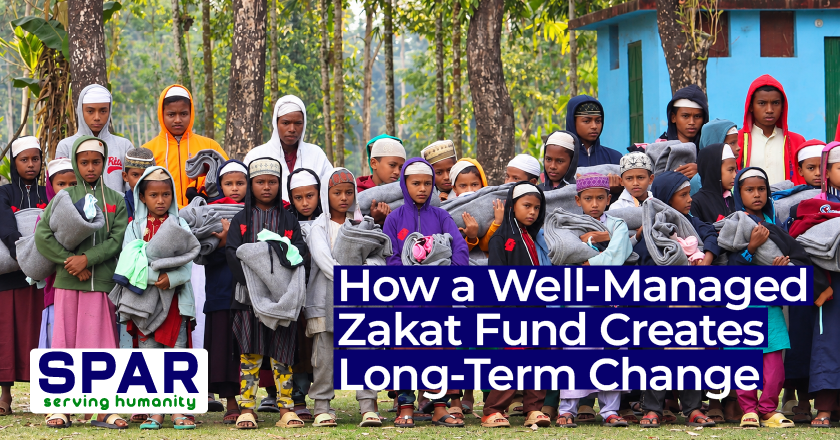
A Zakat fund isn’t just emergency relief. When managed well, it breaks cycles. UNDP research shows that households lifted out of extreme poverty are far less likely to fall back if they receive consistent support over two or three years rather than a one-time grant. That consistency is the point. Families in Rohingya displaced communities, Palestinian households, and Bangladeshi villages dealing with seasonal flooding don’t need one good year. They need a reliable floor to stand on while they rebuild. Real change here is rarely sudden. It comes from small, sustained efforts. Season after season.
What You Now Know About Your Zakat Fund
A Zakat fund is only as strong as its structure. The World Bank estimates that when aid reaches recipients through accountable channels, its long-term impact on poverty reduction doubles. That gap matters. Knowing your Zakat reaches a fund built on transparency, correct nisab calculation, and verified recipient categories changes what your worship produces. Zakat al-Mal, Zakat distribution rules, and Islamic finance principles all point to the same outcome: structured giving creates lasting change. SPAR’s work across the communities we serve reflects that standard, season after season.
How to Recognise a Trustworthy Zakat Fund
Not every fund is equal. A credible Zakat fund publishes its recipient categories openly. It names the eight categories from Surah At-Tawbah (9:60). It calculates nisab against a consistent benchmark, either gold or silver, and explains which it uses. It reports on distribution timelines. These aren’t extras. They are the minimum an accountable fund owes its donors.
When Small Contributions Add Up
UNICEF data shows that consistent annual contributions, even modest ones, reduce long-term food insecurity in displaced communities far more than one-time emergency grants. A Zakat fund that receives steady zakatable assets each year can plan ahead. It can hire trained caseworkers. It can reach families before a crisis deepens. That rhythm of reliable giving is how a fund moves from relief to real change.
Behind every family that rebuilds is a long line of people who stayed involved. They didn’t wait for a headline. They gave because the obligation was clear and the need was ongoing. At SPAR, that commitment runs through every program we run across the regions we serve. The work doesn’t pause between seasons, and neither does the need. See how this work continues.