
Building a masjid as sadaqah jariyah means funding a mosque so that its reward flows back to you continuously, even after you die. Unlike a one-time gift, this act keeps giving as long as people pray inside. The Prophet Muhammad (peace be upon him) named it among the three deeds that survive death, alongside beneficial knowledge and a righteous child who prays for you. It applies to any Muslim who wants their good deeds to continue beyond their lifetime. Few acts in Islam carry this kind of permanent weight.
Why Building a Masjid as Sadaqah Jariyah Matters Right Now
Across the Muslim world, many communities still lack a proper place to pray. Families gather in cramped rooms or open fields because no masjid exists nearby. According to the Pew Research Center, the global Muslim population is growing faster than any other faith group, yet access to places of worship has not kept pace. A masjid does more than hold prayers. It anchors a community. It becomes a school, a shelter, and a gathering point for decades. That’s exactly why our masjid build program at SPAR treats every project as a long-term investment in a community, not just a construction task. Every salah prayed inside adds to your scale of deeds.
Key Facts About Building a Masjid as Sadaqah Jariyah
The hadith most scholars cite comes from Sahih Muslim (Book 13, Hadith 1631), where the Prophet (peace be upon him) said that when a person dies, all deeds stop except three, and building a place of worship falls under ongoing charity. Imam an-Nawawi confirmed this in his commentary on Sahih Muslim, calling sadaqah jariyah one of the clearest proofs that good deeds can outlast the person who did them. Scholars also note that you don’t need to fund an entire masjid alone. Contributing any part, whether a door, a roof, or a water source for wudu, still qualifies. In many regions SPAR serves, a complete village masjid costs around $5,000 to $8,000 USD, making collective giving a real option for most donors.
Do You Have to Fund an Entire Masjid Alone?
No. Most scholars agree that contributing any part of a masjid counts as sadaqah jariyah. You could fund the roof, the wudu area, the lighting, or even a single door. Ibn Baz and Ibn Uthaymeen both addressed this in their fatawa, confirming that partial contributions still carry the same spiritual weight. What matters is sincere intention and a real, lasting contribution to the building. Across the regions where SPAR works, masjid projects often come together through pooled giving. Ten families contributing $500 each can complete a full village masjid. The reward belongs to all of them.
Common Misconceptions About Masjid Sadaqah Jariyah
Many Muslims assume build a masjid sadaqah jariyah only applies to wealthy donors. This isn’t true. The hadith in Sahih Muslim (Book 13, Hadith 1631) makes no mention of a minimum amount. Another common mistake is thinking the masjid must be grand or large. According to classical scholars like Imam an-Nawawi, a simple structure used for regular prayer qualifies fully. Some donors also worry that giving through an organization reduces their reward. But scholars clarify that the reward comes from the deed itself, not the method of delivery. What matters is that the masjid stands and people pray inside it.
Does the Masjid Need to Stay in Use?
Yes. The ongoing reward depends on the masjid remaining a place of active worship. A masjid that falls out of use or closes down would no longer generate new deeds for the donor. This is why location matters so much. SPAR’s approach focuses on communities that already gather for prayer but lack a proper structure. These communities don’t need convincing. They need a building. That steady, active use is what turns a one-time gift into decades of continuous reward.
What If You Give but the Masjid Isn’t Built?
This situation does arise. Funds are collected, but a project stalls or shifts. In these cases, scholars say the donor’s intention still counts if they gave sincerely and the money was handled properly. But it highlights why transparency matters. Donors should look for clear project tracking, honest communication, and field teams that report back. At SPAR, we share updates from the communities we serve so donors know exactly where their support landed.
Who Benefits Most From a New Masjid?
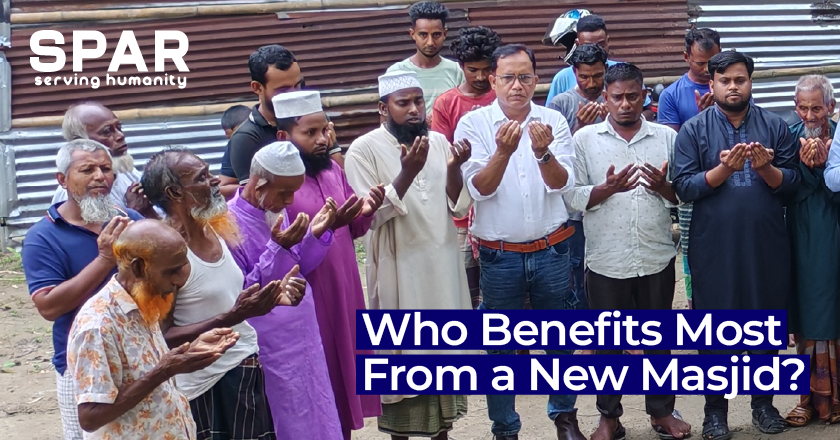
The immediate benefit goes to the local community. But the ripple effect is wide. According to UNICEF, over 300 million children globally live in extreme poverty, and many are in areas with no access to Islamic education. A masjid fills that gap. It becomes the first school many children attend. It becomes a space for women to gather safely. It serves as a shelter during floods or displacement. In Bangladeshi villages and across Rohingya communities in Cox’s Bazar, a masjid often acts as the first permanent structure a displaced family relies on. Change like this doesn’t happen in one season. It depends on quiet, steady support from people far from the need.
How Does Build a Masjid Sadaqah Jariyah Fit Into a Giving Plan?
Sadaqah jariyah sits in a different category from zakat and annual giving. Zakat clears a yearly obligation. But build a masjid sadaqah jariyah is a long-term investment in ongoing reward. Many scholars recommend balancing both. You meet your annual duty through zakat, then you add sadaqah jariyah projects to build something that outlasts you. A masjid can serve a community for fifty years or more. Every salah prayed inside adds to your record of deeds, long after you’re gone. That’s a different kind of wealth. And it costs far less than most donors expect.
What Build a Masjid Sadaqah Jariyah Means for Your Giving
Sadaqah jariyah through a masjid is one of the most studied forms of ongoing charity in Islamic scholarship. Scholars like Imam al-Nawawi placed it among the highest categories of sadaqah precisely because its benefits flow continuously. A masjid serves prayers, education, community gatherings, and shelter for decades. UNICEF estimates over 300 million children live in extreme poverty globally, many in areas with no access to structured learning. A masjid built in such a community does not just serve the ummah today. It serves generations not yet born.
Does the Intention Matter When You Build a Masjid?
Yes. Scholars of fiqh are clear: intention (niyyah) shapes the reward. Ibn Qayyim al-Jawziyyah wrote at length about niyyah determining the scale of spiritual return. If you intend the masjid as sadaqah jariyah for a deceased parent, a living relative, or yourself, that intention is valid and rewarded. State it before you act. The physical act and the spiritual intention work together. One without the other misses the full weight of what the Prophet Muhammad (peace be upon him) described as deeds that outlast a person’s life.
How Does This Fit Alongside Zakat and Other Giving?
Zakat clears a yearly obligation. Sadaqah jariyah builds beyond it. Many scholars recommend meeting your zakat first, then choosing one or two sadaqah jariyah projects to sustain through your life. A masjid is a natural choice because its benefit is communal, lasting, and spiritually compounding. As the Quran states in Surah At-Tawbah (9:18), those who build and maintain masajid are among the believers who trust in Allah and the Last Day. That is the standard to aim for.
Behind every masjid still standing after forty years is a person who made a quiet decision. They chose something permanent over something visible. At SPAR, that kind of long-term thinking shapes how we approach community building across the regions we serve. The work is steady, not seasonal. It runs because people choose to stay involved beyond the moment of giving. See how this work continues at SPAR.