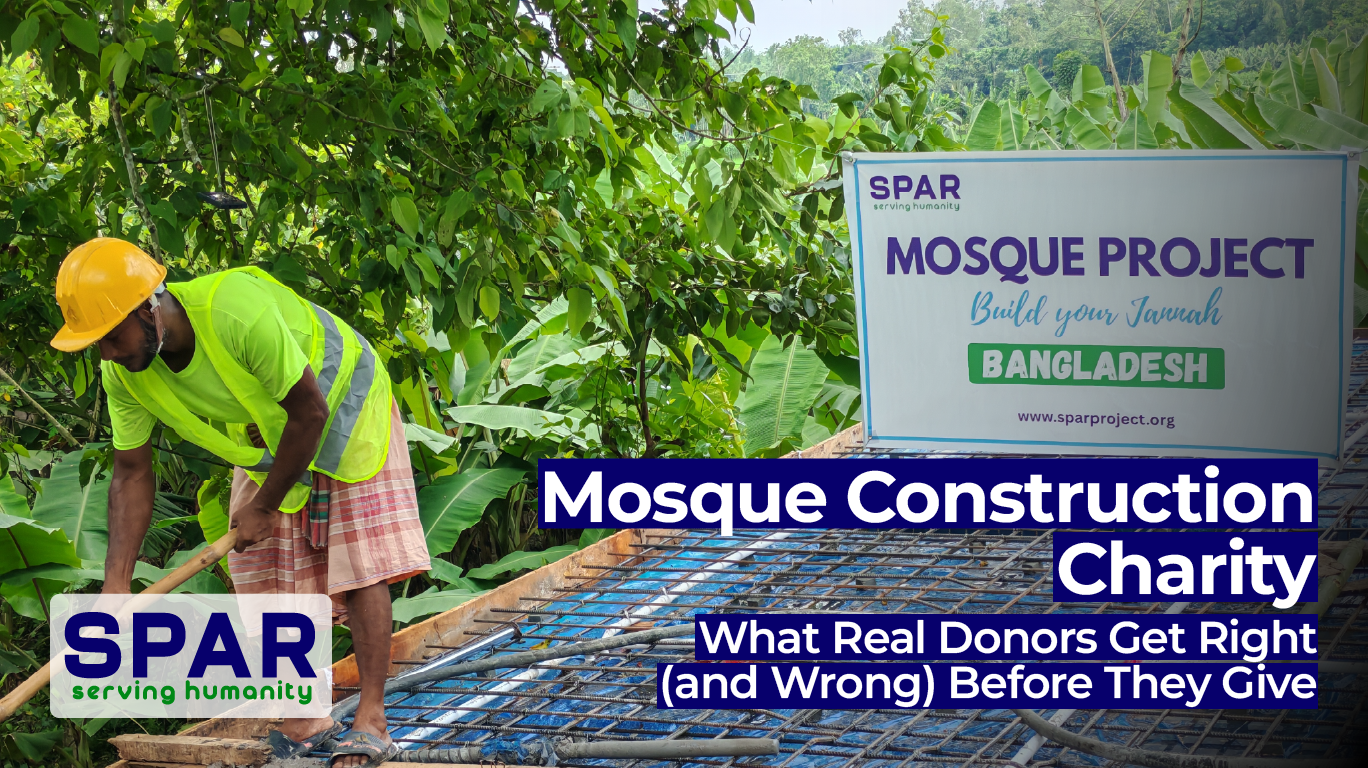
Mosque construction charity is organised giving that funds the building or rebuilding of mosques in underserved communities. Unlike one-time aid, this form of charity creates a structure the whole community uses for generations. According to Pew Research, Muslims make up about 25% of the global population. Yet in many low-income regions, a mosque can serve thousands of people who have no other place to pray. That gap is what mosque construction charity exists to close.
Why Mosque Construction Charity Matters Right Now
The need for mosque construction is growing faster than many people realise. The global Muslim population is set to reach 2.2 billion by 2030, according to Pew Research. But mosque infrastructure in low-income regions hasn’t kept pace. In parts of sub-Saharan Africa and South Asia, one mosque can serve a catchment of several thousand worshippers. Families walk hours just to reach Friday prayers. That’s not a minor inconvenience. It shapes whether children grow up with regular access to Islamic education and community. At SPAR, we see this across the regions where our teams work. You can learn more about our mosque and community infrastructure work. Building a mosque doesn’t just solve a logistical problem. It anchors a community’s identity for decades.
Key Facts About Mosque Construction Charity Most Donors Don’t Know
Mosque construction charity isn’t just a modern fundraising idea. It traces back to the Prophet Muhammad (peace be upon him), who said: “Whoever builds a mosque for Allah, Allah will build for him a house like it in Paradise” (Sahih al-Bukhari, Book 8, Hadith 441). That’s why scholars like Imam al-Nawawi classified mosque building among the highest forms of sadaqah jariyah, ongoing charity that earns reward after death. In practice, construction costs vary widely. A basic rural mosque in low-income regions can cost as little as $3,000 USD. A full community centre with classrooms and washing facilities can run $30,000 USD or more. The World Bank notes that infrastructure investment in underserved communities produces some of the highest long-term social returns of any aid category. Mosque construction sits exactly there.
What Types of Mosque Construction Charity Projects Actually Exist?
Mosque construction charity covers a wide range of projects. It isn’t one fixed model. At the smallest scale, a basic prayer shelter serves a few dozen families. It might cost as little as $3,000. A mid-range build adds proper ablution facilities, a small library, and a dedicated space for children’s Quran classes. This sits closer to $15,000. Full community mosque complexes, with classrooms, a funeral preparation room, and space for local gatherings, can reach $30,000 or more. According to the UN Human Settlements Programme, community buildings in low-income urban and rural areas return lasting social value far beyond their construction cost.
Rural Prayer Shelters
Rural prayer shelters are often the first step. They serve isolated communities where the nearest mosque may be miles away. These structures are simple. But they matter. A family that prays in congregation stays connected to faith, to neighbours, and to a shared identity. For many Bangladeshi villages, a basic prayer shelter is the first permanent public building the community has ever shared. It becomes a meeting point for education, for funerals, for Eid celebrations. This single structure can change a village’s entire social texture.
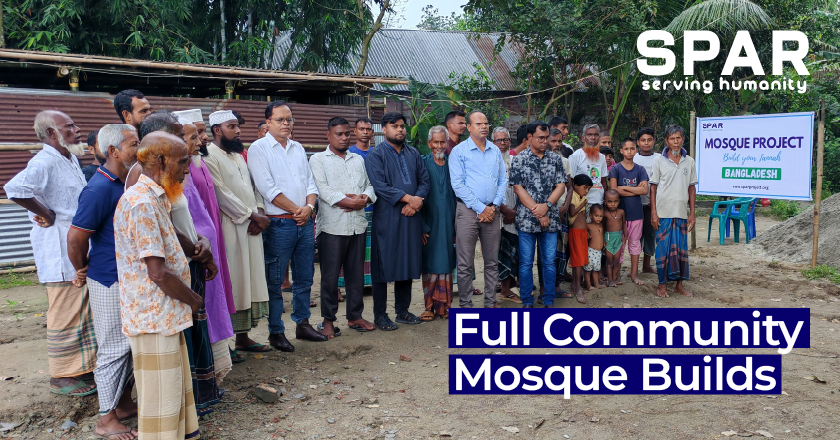
Full Community Mosque Builds
A full community mosque does more than house prayer. It holds funeral rites. It runs Quran memorization classes for children. It stores emergency supplies after floods. In areas affected by displacement, like Rohingya communities in Cox’s Bazar, a mosque gives scattered families a fixed point to return to. SPAR’s work in the regions we serve shows this pattern clearly. The mosque becomes the one place the community agrees belongs to everyone. Real change here is rarely sudden. It comes from small, sustained efforts, season after season.
Common Misconceptions About Mosque Construction Charity
Many donors assume mosque construction charity only helps wealthy Gulf communities build grand structures. That’s not the case. Most mosque construction charity work focuses on underserved rural areas, displaced populations, and low-income urban zones across Africa, South Asia, and the wider Muslim world. Another common mistake is thinking a mosque is a luxury project. But for communities without running water or paved roads, a mosque is often the only shared public building they have. UNICEF research on community infrastructure in low-income regions confirms that shared civic spaces improve child education outcomes and maternal health access.
Who Benefits Most From Mosque Construction Charity?
The communities that gain most are those already facing the biggest barriers. Rohingya families in displacement camps have no permanent structures. Bangladeshi families in flood-prone river delta regions lose buildings regularly. Somali and Sudarian communities rebuilding after conflict need gathering spaces before most other civic buildings. These are not wealthy communities funding prestige projects. They are families who cannot afford a cement floor, let alone a prayer hall. According to World Bank data, communities with shared civic infrastructure show measurably better long-term recovery after natural disaster and displacement.
Children and Youth
Children gain the most visible benefit. A mosque with a dedicated classroom gives children access to Quran education and basic literacy. In areas where state schools are absent or underfunded, this matters. Imam-led learning circles have historically filled education gaps across South Asia and sub-Saharan Africa. They still do. Many adults across the regions where SPAR works today learned to read inside a mosque. That pattern continues.
Elderly and Widowed Community Members
Elderly men and women, and especially widowed women, often lose their social network after a spouse dies. A functioning mosque gives them a daily reason to leave home. It connects them to community prayers, to the weekly khutbah, and to people who notice if they don’t show up. The teams working on this don’t make headlines. They show up, week after week, because they know that a building can hold a community together long after the builders have gone.
What Mosque Construction Charity Means in Practice
Choosing a mosque construction charity is a choice to invest in a community’s long-term foundation. The World Bank links shared civic infrastructure to stronger recovery after displacement and disaster. A prayer hall becomes a school. A school becomes a meeting point. A meeting point becomes a place where the isolated find company and the grieving find comfort. SPAR’s work reflects this pattern. The buildings are modest. The outcomes are not. Communities that gain a functioning mosque gain something harder to measure than bricks: a reason to stay, to rebuild, and to come back.
Does the Building Type Matter?
It does. A temporary shelter serves an immediate need. A permanent mosque serves every generation that follows. Construction material, drainage design, and structural integrity all affect how long a mosque stands. In flood-prone regions, raised foundations and water-resistant materials add years to a building’s life. A mosque built well requires less repair and stays open longer. That longevity is part of what makes permanent mosque construction a different category of giving from emergency relief.
What Happens After the Mosque Opens?
The opening is not the end. Communities need imams, basic furnishings, and ongoing maintenance. Waqf models, used across the Muslim world for centuries, provide endowment funds tied to a mosque’s upkeep. Modern charities adapt this by pairing construction with community training. SPAR’s approach follows this logic. Building the structure is phase one. Making sure it functions for the community that uses it is the work that continues long after the builders leave.
Behind every mosque that stands today is a chain of decisions made by people who never saw the finished result. They gave when the land was empty and the need was clear. At SPAR, that same commitment shapes how the work moves forward. The communities we serve are not waiting for perfect conditions. They build with what they have, in the places where they live. See how this work continues at sparproject.org/our-work.