
Wudu sadaqah jariyah is the ongoing spiritual reward earned when you fund clean water that Muslims use for ritual purification. It differs from regular sadaqah because the reward continues after your death. Muslims pray five times daily, so the reward multiplies with each act of wudu made possible by your gift. It applies to any Muslim who gives toward a water source used for worship. And scholars agree it’s among the most powerful forms of continuing charity in Islam.
Why Wudu Sadaqah Jariyah Matters Right Now
Access to clean water shapes whether millions of Muslims can even perform wudu with ease. According to UNICEF, about 2.2 billion people worldwide still lack safe drinking water at home, many of them in Muslim-majority communities across sub-Saharan Africa, South Asia, and parts of the Middle East. When water is scarce, wudu becomes a daily struggle. That’s why funding a water source isn’t just an act of charity. It’s an act of worship that outlives you. Scholars like Imam al-Nawawi noted that sadaqah jariyah rewards flow as long as the benefit continues. SPAR’s ongoing clean-water work connects this timeless principle to real communities that need it most. Every well, tank, or pump built for communities to use also serves as a place of purification before prayer.
Wudu Sadaqah Jariyah: What Most People Don’t Know
Most donors think of sadaqah jariyah as building a mosque or sponsoring an orphan. But the connection between water charity and wudu is older and more precise than most people realise. The Prophet Muhammad (peace be upon him) said that when a person dies, their deeds end except for three things, including sadaqah jariyah (Sahih Muslim, 1631). A water source used for wudu fits this hadith directly. Pew Research puts the global Muslim population at about 1.8 billion, meaning billions of prayers happen daily worldwide. Each prayer requires wudu. And each act of wudu made possible by your gift counts toward your account. That’s not a small thing.
Does Wudu Sadaqah Jariyah Require a New Intention Each Time?
Many donors ask whether one gift covers all future worship, or whether the reward depends on ongoing intent. The answer, according to classical scholars, is straightforward. You give once. The reward flows from the benefit, not from repeated intention. Imam al-Nawawi wrote in his commentary on Sahih Muslim that sadaqah jariyah rewards continue as long as the action itself continues to benefit others. So a water source used daily for wudu generates reward daily, without any further act on your part. Your initial niyyah, your sincere intention at the point of giving, is enough. The deed carries itself forward.
What If You Give Anonymously?
Giving without public recognition doesn’t reduce the reward. Ibn Qayyim al-Jawziyyah noted that private charity is among the most beloved deeds to Allah, because it protects sincerity. An anonymous well still serves a family’s wudu. It still enables salah. Reward doesn’t travel through recognition. It travels through use. So whether your name is on a plaque or known only to Allah, the reward is the same, and arguably purer for the privacy.
What If the Water Source Is Shared With Non-Muslims?
Classical fiqh doesn’t restrict the reward to Muslim-only use. A water source that serves a whole community, Muslim and non-Muslim alike, still generates continuous reward from the Muslim worshippers who use it for wudu and ritual purity. The non-Muslim benefit doesn’t cancel the sadaqah jariyah. Scholars of the Hanbali and Shafi’i schools both affirm this. The key condition is that the source genuinely enables worship. Where that’s true, the reward flows.
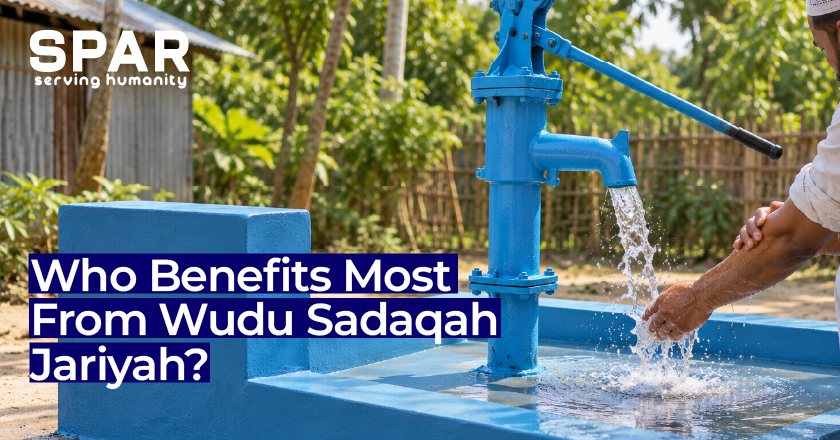
Who Benefits Most From Wudu Sadaqah Jariyah?
The communities with the most to gain are those where clean water is hardest to reach. According to WHO, about 2 billion people worldwide lack access to safe drinking water at home. In many of those communities, water collection falls on women and girls, often taking hours per day. For Muslim families in water-stressed regions, this means wudu is delayed, rushed, or done with water that isn’t fully clean. Children miss the habit of ritual purity before prayer. Elderly men and women go without. The gap between obligation and access is real, and it falls heaviest on the poorest families.
Displaced and Refugee Communities
Rohingya families in temporary settlements face some of the hardest water conditions of any Muslim community on earth. UNHCR data shows that water access in large displacement camps rarely meets the minimum humanitarian standard of 15 litres per person per day. For a family performing five prayers, wudu alone needs clean, sufficient water. Displaced communities across sub-Saharan Africa face the same problem. Sudarian families in conflict-affected areas often travel long distances for water that isn’t safe for drinking, let alone ritual use. Real change in these communities is rarely sudden. It comes from small, sustained efforts, season after season.
Common Mistakes When Giving Wudu Sadaqah Jariyah
The biggest mistake is treating all water charity as equal. Not every water project creates sadaqah jariyah. The classical condition is that the benefit must be ongoing. A one-time distribution of bottled water, while valuable, doesn’t meet this standard. Only a permanent or semi-permanent source, a well, a pump, a tank with regular maintenance, qualifies under the scholars’ definition. A second mistake is ignoring maintenance. A well that breaks down and sits unused generates no reward. SPAR’s approach to clean-water work includes long-term maintenance checks, because a functioning source is the only kind that keeps giving. The third mistake is waiting. Every day without a source is a day of missed wudu for real families.
What Wudu Sadaqah Jariyah Means for You Right Now
The core idea is simple. Water given for wudu is water that keeps earning. Every time a family performs wudu at a source you helped build, the reward flows back to you. UNICEF estimates that 2 billion people still lack safe water at home. For millions of Muslim families, that means wudu is a daily struggle. A permanent water source changes that. It turns one act of giving into years of continuous reward. SPAR’s long-term water programs exist for exactly this reason. The work continues, season after season, because the need does too.
Does the Source Need to Be a Well?
Not exactly. Scholars agree the key condition is permanence, not the form. A borehole, a hand pump, a rooftop tank with regular upkeep, all can qualify. What matters is that the source stays functional. A broken pump earns nothing. This is why maintenance is not optional. It is part of what makes the original act of sadaqah jariyah valid. The source must keep giving for the reward to keep flowing.
Who Benefits Most From Wudu Sadaqah Jariyah?
Displaced and rural communities carry the heaviest burden. Rohingya families in temporary settlements, Sudarian communities in conflict-affected zones, and families in flood-prone lowlands all face the same problem. Unsafe or distant water forces impossible choices. Drinking wins. Wudu loses. Children in these communities often grow up without ever performing wudu from a clean, permanent source. A single well changes the daily rhythm of an entire household and then the entire village.
Behind every functioning well is a quiet decision someone made. They chose to give once, and the source kept going. That is the mechanics of sadaqah jariyah. SPAR’s water work follows the same logic. Programs in the communities we serve don’t run on momentum. They run on the continued attention of people who understand what ongoing giving actually means. The families at these sources perform wudu five times a day. The reward keeps moving. See how this work continues.