


How to Pay Kaffarah: 2026 Rules for Broken Ramadan Fasts
We all have those moments where our strength fails us. Maybe it was a scorching summer afternoon, or perhaps you just had a moment of weakness and reached for a snack. Whatever the reason, if you intentionally broke your fast during Ramadan, you are likely feeling a heavy sense of regret. Fortunately, Islam offers opportunities for forgiveness.
You may be wondering how to pay kaffarah to settle your debt and begin anew. Kaffarah is a beautiful way to turn a mistake into a massive blessing for someone else. It serves as a spiritual reset, providing sustenance to the underprivileged while simultaneously cleansing your own soul. In this guide, we’ll walk through the 2026 rules and costs so you can fulfill your duty with confidence.
What Exactly Is Kaffarah, and Why Is It Necessary?
Kaffarah isn’t just a “fine” you pay like a parking ticket. It is a profound act of worship. In the Arabic language, the word comes from a root that means “to cover.” Essentially, your charitable deed—feeding the poor—covers up the sin of breaking the fast. When you look at how to pay kaffarah, you are looking at a path of atonement. It shows Allah (SWT) that you recognize the sanctity of the month of Ramadan and that you are truly sorry for your lapse in judgment.
This penalty exists because fasting is a pillar of Islam. It is a sacred contract between you and your Creator. When that contract is broken deliberately, the “repair” must be significant. It isn’t just about the food; it’s about the discipline and the realization that our actions have consequences. By helping someone who struggles to find their next meal, you gain a deeper appreciation for the very fast you missed.
Why do people often confuse Kaffarah and Fidya?
If you are browsing the SPAR Project website, you might see two different terms: “fidya” and “kaffarah.” They are not the same thing, and paying the wrong one won’t fulfill your obligation.
- Fidya is intended for individuals who are unable to fast. Maybe you have a chronic illness, you are elderly, or you are pregnant and worried about the baby. Since you have a valid excuse, the “payment” is small—usually just feeding one person per day.
- Kaffarah is intended for individuals who have chosen not to fast. If you were healthy and capable but broke the fast anyway, you fall into this category. The penalty is much higher because it serves as a deterrent and a serious act of repentance.
Always double-check your situation before you donate. If you’re unsure, it’s a good idea to chat with a local Imam. But generally, if it was a choice rather than a necessity, you are looking at kaffarah.
The Two Main Ways to Settle Your Debt
When you research how to pay kaffarah, the Shariah actually gives you a few options. Traditionally, the first was to free a slave, but that obviously doesn’t apply today. That leaves us with two modern paths:
- Fasting for 60 Days: This method is the primary requirement. You must fast for 60 consecutive days for every single fast you broke. “Consecutive” means you cannot miss a single day. If you make it to day 59 and stop, you have to start all over again from day one.
- Feeding 60 Poor People: If you are physically unable to handle a two-month fast—perhaps due to work demands or health issues—then you must feed 60 needy people. This is where most people turn to charities like SPAR Project to ensure the food reaches the right hands.
Understanding the 60-Day Consecutive Fasting Rule
Fasting for 60 days straight is a massive challenge. It is designed to be rigorous. It forces you to live the experience of Ramadan over and over again until the discipline is etched into your soul. However, Islam doesn’t want to break you; it wants to build you.
There are only a few valid reasons to pause the 60-day count. For women, their monthly cycle is a natural break that doesn’t “reset” the clock. But for almost everyone else, any break means starting over. This is why many people who work physically demanding jobs or have health fluctuations choose the feeding option. It ensures the religious duty is met without putting their health at risk.
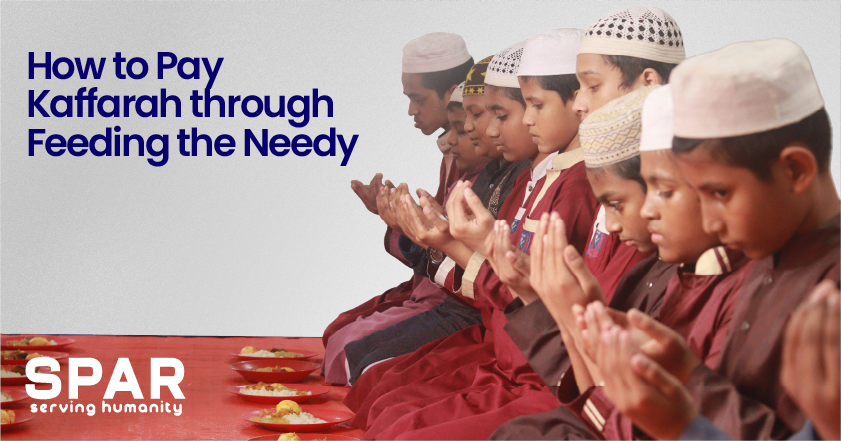
How to Pay Kaffarah Through Feeding the Needy
If you’ve decided that feeding the poor is the right path for you, you need to know the logistics. You aren’t just giving a few dollars to a person on the street. To fulfill the kaffarah, you must provide two full meals to 60 different poor people.
Many donors find it difficult to track down 60 eligible people in their local neighborhood. That is why we facilitate this at SPAR Project. We identify 60 individuals in Bangladesh who are truly in need. We then use your donation to provide them with substantial food. The process runs smoothly: you make a donation, we distribute it, and you gain the assurance that we’ve fulfilled your obligation accurately.
Calculating Your 2026 Kaffarah Costs
Money values change every year because of inflation and the cost of grain. For 2026, the estimated cost to feed one person a decent meal is around $5. Since you have to feed 60 people, the math is simple: $5 x 60 = $300.
If you broke more than one fast, you generally multiply that amount. However, some scholars in the Hanafi school say that one kaffarah might cover multiple broken fasts within the same Ramadan. It is vital to check with your specific school of thought (Madhhab) to be 100% sure. For a broken oath, the cost is much lower—usually around $50 to feed 10 people.
Why We Focus on Families in Bangladesh
You might wonder why SPAR Project sends kaffarah money to Bangladesh. The reason is simple: your dollar goes much further there. In some parts of the world, $300 is just a nice dinner for a few friends. It is literally possible to feed 60 people in rural Bangladesh with $300 and still have leftovers for their families.
We work in areas where poverty is not just a statistic; it’s a daily struggle. Many people we serve are widows with young children or elderly folks with no one to care for them. When you pay your kaffarah through us, you aren’t just checking a box on a religious to-do list. You are providing a lifeline to a human being who might have gone to bed hungry without your help.
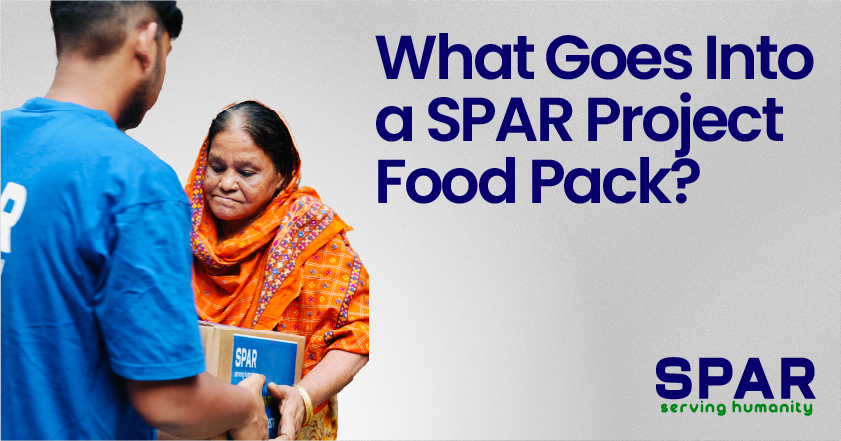
What Goes Into a SPAR Project Food Pack?
When we fulfill your kaffarah, we don’t just hand out random items. We create “Food Packs” that are culturally appropriate and nutritious. We want the people receiving your gift to feel respected and fed.
A typical pack in Bangladesh includes:
- A large bag of rice: The main staple for every meal.
- Lentils (Dal): A vital source of protein.
- Cooking Oil: Something many poor families can’t afford.
- Dates: To honor the Sunnah of the Prophet (PBUH).
- Salt, sugar, and chickpeas: The basics needed for a traditional Iftar.
These items are bought locally. The purchase helps the local economy and ensures the food is fresh. Your kaffarah becomes a community-wide blessing.
Can You Pay Your Kaffarah in Cash?
In the early days of Islam, people would give actual containers of grain or dates. Today, most of us live in a cash-based world. So, is it okay to just click “donate” on a website? The answer is yes, as long as the organization uses that money to buy food.
When you donate to SPAR Project, you are appointing us as your Wakil (agent). You provide us the funds, and we take on the responsibility of buying and distributing the food. This concept is perfectly valid according to modern scholars. It is often much better for the recipient too, as they receive high-quality food that they actually know how to cook and eat.
Common Mistakes People Make with Kaffarah
Even with the best intentions, it’s easy to slip up when figuring out how to pay kaffarah. One common error is thinking that paying the money means you don’t have to make up the fast. You actually have to do both. You pay the kaffarah as a penalty, but you still owe that one day of fasting back to Allah.
Another mistake is using Zakat money to pay for kaffarah. Kaffarah is a separate expense. Think of it as a personal debt. You shouldn’t use your Zakat “budget” to cover your own mistakes. Finally, please ensure you avoid any delays. If you owe kaffarah from last year, try to pay it before the next Ramadan starts. It’s always better to meet Allah with a clean slate.
The Concept of Amanah: Why Trust Matters
When you send $300 across the world, you are trusting a charity with your spiritual obligation. This is what we call Amanah (trust). At SPAR Project, we don’t take this lightly. We know that if we don’t distribute your kaffarah correctly, your religious duty remains unfulfilled.
That is why we are so transparent. We track every donation and ensure it goes to the people who meet the Islamic criteria for being “poor” (Masakin). We believe that being a bridge between a donor’s repentance and a hungry person’s meal is a sacred task. We do the hard work on the ground so you can focus on your spiritual growth.
Turning Your Mistake Into a New Beginning
It’s easy to beat yourself up over a missed fast. You might feel like you’ve failed. But the existence of kaffarah proves that Allah wants you to succeed. He provided a way for you to make amends.
Think of this experience as a journey. You had a moment of weakness, you acknowledged it, and now you are doing something incredible to fix it. That $300 isn’t just a “penalty”—it’s 60 smiles. It’s 60 full stomachs. It’s 60 people making Du’a for the person who fed them. When you look at it that way, kaffarah becomes one of the most beautiful acts of charity you can ever perform.
Final Thought
Ultimately, we are all human. We stumble, we fall, and we make mistakes. However, the beauty of Islam lies in the constant availability of repentance. Learning how to pay kaffarah and following through with it is a sign of a strong believer. It shows that you care more about your standing with Allah than your bank account. If you owe a kaffarah, don’t wait. Use this guide to calculate your amount, choose the feeding option if you need to, and let SPAR Project help you deliver that meal to someone in Bangladesh who is waiting for a miracle.
What happens if I can’t afford the $300 kaffarah?
If you are genuinely struggling financially and cannot afford to feed 60 people, your only option is to fast for the 60 consecutive days. If you are also physically unable to fast, you should consult a scholar. In cases of extreme poverty and illness, Allah is the Most Merciful and may waive the requirement, but this is a rare ruling.
Can I feed one person for 60 days instead of 60 people for one day?
Most scholars, especially in the Hanafi school, say this is acceptable. The goal is to provide 60 “person-days” worth of food. However, many charities prefer to feed 60 different people to spread the benefit wider and ensure the requirement is met quickly and clearly.
I broke my fast because I was traveling. Do I owe kaffarah?
No. Travel is a valid excuse to miss a fast. You only owe a make-up fast (Qada) for that day. Kaffarah is only for when you break a fast with no Islamic excuse at all.
Is the kaffarah for a broken oath the same as for a fast?
No, they are different. A broken oath requires you to feed 10 poor people (around $50 in 2026). Breaking a Ramadan fast intentionally is much more serious and requires feeding 60 people ($300).
Can a woman pay kaffarah if she broke her fast intentionally?
Yes. The rules are the same for men and women. The only difference is that if a woman chooses the 60-day fasting option, her period does not break the “consecutive” requirement; she simply pauses during those days and continues immediately after.
Do I have to pay kaffarah if I accidentally ate something?
No! If you truly forgot you were fasting and ate or drank, your fast is still valid. The Prophet (PBUH) said that Allah was the one who fed you in that moment. You don’t owe anything—not even a make-up fast.
Why is the cost $300? Can I pay less?
The $300 is based on the average cost of two nutritious meals ($5) multiplied by 60 people. While you might find cheaper ways to feed people, we ensure the meals are of a high standard so that your kaffarah is accepted and the recipients are well-fed.


 Secure
donation
Secure
donation